
As an unusual tree I’ve always liked the Dawn Redwood, Metasequoia glyptostroboides. It was known only from fossil record and thought extinct until a small grove was found in a mountain valley in China in 1946. There was a wave of popularity and a bunch were planted worldwide, which are now mature and easy to find if you want to see one. They grow well and very quickly in cool to temperate climates. They have little tiny deciduous needle-leaves that don't need to be raked, and grow tall and symmetrical without spreading too wide.
https://en.wikipedia.org/wiki/Metasequoia_glyptostroboides
I started 2 sprouts I bought by mail order, after one growing season they were nearly 3 feet tall. I got them mail order from Jonsteen Nursery, they have been specializing in various redwood saplings for many years. https://sequoiatrees.com/
There are lots of "mature" dawn redwood trees in Princeton NJ - particularly in a specific neighborhood built in the 50s.
It makes sense now that the species was discovered in the 40s
Related: There’s no such thing as a tree (phylogenetically)
https://eukaryotewritesblog.com/2021/05/02/theres-no-such-th...
There's no such thing as a fish either. Unless you count whales, parrots and Kanye West as fish.
"Fish" is almost a good category, you only need to nuke a unusual branch and call it a day.
A better comparison is "Fliyers", that include most insects, most birds, bats, pterodactyls and perhaps a few gliding and kitting animals. It evolveded and disappeared a few times.
If you like trivia and British humor the podcast No Such Thing as a Fish is amazing.
Thank you! Isn’t it amazing how a rigid hierarchical categorization system fails everywhere you actually look into details? See also category theory vs prototype theory.
It's amazing that most people don't realize it, and even in higher education you get people believing in taxonomies and categories as if they were a property of the natural world. There are no categories in the objective reality, rigid or otherwise; there are no metadata tags attached to elementary particles, that say what the arrangement they're part of is, and of what type it is. Whether in biology or in code, taxonomies are arbitrary - they're created by people for some specific purpose, and judged by useful they are in serving that purpose.
You'd think that now that we have LLMs, the actual in-your-face empirical evidence of a system that can effectively navigate the complexities of the real world without being fed, or internally developing, rigid ontologies, that people would finally get the memo - but alas.
Indeed, one of the epistemological lessons for me when confronting the power of LLMs is that a sort of "intellectual capability" can emerge in any system, from sheer scale/complexity alone.
If you're interested, check out Rupert Sheldrake:
https://www.sheldrake.org/files/pdfs/papers/Is_the_Sun_Consc...
It's the same people complaining tomato is fruit, so it must not be a vegetable.
Relatedly I just noticed potato fruit (potato berries) the other day: https://en.wikipedia.org/wiki/Potato_fruit
Part of the same Solanaceae/nightshade family also includes bell peppers and eggplants. To help confuse the Tomato plant and the Tomato vegetable further.
Well, no, what we're saying here is that if you use a rigid, hierarchical catergorisation system (cladistics) you can say that there is no such monophyletic grouping as a fish. Ie there is no grouping with a common ancestor that encompasses all the things, and only the things, that we commonly call fish. That system hasn't failed, it's fine, its purpose is to categorise things in terms of evolutionary descent. However, under that system humans are reptiles and trees and fish aren't useful categories. There exist other systems of catergorisation, which are polyphyletic or paraphyletic, which fit better with commonly used language, and we get back fish, trees, non-avian non-mammalian reptiles. Neither of them are wrong, they're just differently used and differently useful. It's like knowing that a tomato is a fruit, but nobody wants it in a fruit salad. People tend to struggle when things exist in multiple naming systems and categories for some reason.
Correct me if I'm wrong, but I don't think humans are reptiles, phylogenetically. The Synapsida (containing mammals) and Sauropsida (containing reptiles) are sibling groups inside the Amniota.
AFAIK - Synapsida were originally termed mammal-like reptiles before the Amniota group was applied.
You're probably right I'm no expert
Agree. Latour's got neat arguments too (commenting on Pandora's Hope)
I would say the Eucalyptus tree, planted all over the world but native to Australia, is quite unusual.
Young Eucalyptus trees have leaves that are rounded and are arranged opposite to one another. However, when mature the leaves of a Eucalyptus are lance-like and are arranged in an alternating fashion. This to me is quite unusual.
I agree eucalypts are unusual, I also find them beautiful, especially ones with smooth light bark like Ghost Gum and Citriodora, which has light pinky-orange bark! Such a presence!). I've never seen a Rainbow Gum but would love to one day!
I live in South Australia and I was surprised to hear about all Eucalypts having 'leaf dimorphism' (that is what I searched for, then learned that it's usually known as 'heteroblasty') I have of course seen it many times in-the-wild, but it is not universal to all Eucalypts.
Banksia, Grevillea and Hakea are also very beautiful Australian native trees/shrubs imo, but they are a different group: Proteaceae. And there's a fascinating fruiting small tree called 'Quandong' that's in the Sandalwood family (still seems bit related to eucalypts or maybe Wattle (Acacia) when looking at it in real life though).
As someone who grew up with a Quandong in their backyard please don’t plant quandongs without serious planning
It grew 40m in ~10 years and spanned ~200-300m^2
It's funny, a neighbor had me cut their eucalyptus down, then it grew back from the stump and I had to cut it again a couple years later. Then I has to cut it again a few years after that. Now it looks like I'm going to have to cut it again soon. It's become a running joke at this point.
Those things are tough, and they grow really fast in the right climate.
All I know about them is they're bad railroad ties, and they explode.
True. Although in their native Australia they grew quite straight. It's the introduced trees that grow not so straight and make bad railroad ties.
In areas where they are introduced, they also become quite invasive by practicing something called alelopathy, whereby they introduce toxins into the soil to prevent competing tree species from taking hold.
While I'm at it, Eucalyptus trees have very very dense wood which means the wood burns very hot. This makes it even worse for forest fires where Eucalyptus trees dominate.
(I knew my botany studies would come in handy someday. I just never knew when!)
Eucalypt forest fires are bad because the leaves are full of oil and when it's hot, dry and windy, they're extremely flammable and the fire races through the tops of the trees at incredible speeds, and jumps across large fire breaks that appear to be wide enough that they should stop it.
But at the same time the wood is also very dense, so makes great campfire wood, but doesn't burn so much in a forest fire, which is a bit ironic...
> While I'm at it, Eucalyptus trees have very very dense wood which means the wood burns very hot. This makes it even worse for forest fires where Eucalyptus trees dominate.
Forgive my ignorance, but I had understood the density of the wood meaning that the trunks of the trees were less likely to burn in a forest fire (which eucalypts encourage by shedding large amounts of dry bark)
Which Eucalyptus tree? There are between 700-900 species and they look nothing alike.
See E. grandis, E. tetraptera, E. chartaboma, E. deglupta, E. pulverulenta for examples of diversity
Some are incredibly tall with really smooth skin, some are basically bushes, some have really messy papery bark; some even have rainbow bark! Some have really long leaves while some have extremely short tightly wound round leaves
An unusual tree I remember fondly as a child, is in the Karri forests of south-western Australia[1] .. we'd driven through a wild and stormy afternoon to get to it, a friend of my mother had gotten permission and the cabin key, as it was closed to the public then - and so it was that we were climbing the slippery, seemingly fragile iron posts that ringed its trunk[2] all the way to the top to find ourselves cramped into a fire lookout cabin .. we camped overnight in tight sleeping bags with a cold can of baked beans and yesterdays toast for breakfast, and I will always remember the lissajous swing of the thing, carefully turning the resonance of the wind into a constant figure 8, around and around, sometimes in minute increments gradually widening and slowing .. but every now and then, a big fast sweep would happen on the wind, and the tree would translate it through an odd crack into a bigger leverage, and that sleep that was so close gets pushed just a bit beyond the conscious horizon as one wondered, literally, if the tree was finally going to fall .. after a hundred or so years .. but still, just a few hours later, all is calm, the bush is slowly thawing out, the relentless sun conquers the horizon, the iron rungs dry out, the trees leaves steam in the morning sunrise, this great behemoths strength feeling safer and safer as we take gravitys' step .. and we are just too soon back on the ground and off for some surf out at Yallingup or so ..
A beautiful living thing which my perception of its rythmic swing has lived on with me for decades. Trees are lovely.
Since we're talking trees. Only trees that grow in an area with distinct warm/cold cycles have rings, tropical trees don't and the only way to tell the age of most tropical trees is to have planted it yourself
Trees that grow in areas with wet/dry cycles also have rings. And since most of the trees from permanently-wet areas also have some kind of annual or semi-annual cycle, I'd guess the ringless ones are a rare exception everywhere.
Wouldn’t a tree without rings still reasonably capture the atmospheric C13:C12 ratio as it grows? Or is the carbon motility within the trunk too high, or the ratio differences too small, to sample a bit near the core and use the ratio there as an age indicator?
Palms and Bamboo are technically "very big weeds". They are more related with grasses than with pines and never have rings. Bananas are also just giant herbs.
So Monocots don't have rings. Anything else that is a tree in a tropical forest has rings. It does not matter where they grow. The rings are smaller in slow growing species, and are different structurally in conifers, but this is all.
The traveller tree looked the most interesting, like a peacock's feather.
https://www.indefenseofplants.com/blog/2017/12/12/the-travel...
Big herb. Not really a woody plant.
One of my favorite trees is Couroupita guianensis, known by a few other names (ayahuma, cannonball tree). When mature the trunks grow some beautiful flowers that can cover the trunk (wiki link has a few good pics). Native to South America, it's a revered tree in Amazonian plant shamanism (all parts of the plant can be used medicinally; spiritually it is one of the big ones, an entire school of its own). It made its way to India in the 1800s where it holds a lot of renown and importance now.
Superb flowers but very dangerous to stay under the cannonball tree.
Related and also interesting: https://en.wikipedia.org/wiki/List_of_individual_trees
The UK has quite a few ancient yew trees. Some may be over 2000 years old. Often they are in church grounds (because ones that weren't got cut down to make long bows perhaps?).
https://www.woodlandtrust.org.uk/blog/2025/08/ancient-yew-tr...
One of the many nice things about nature is that almost everything is interesting and unique in some particular way, be it longevity, size, or far more specific traits, across all species, all domains of natural science.
I was in Brazil for the first time last year and was very impressed with the trees.
Two examples right from downtown São Paulo,
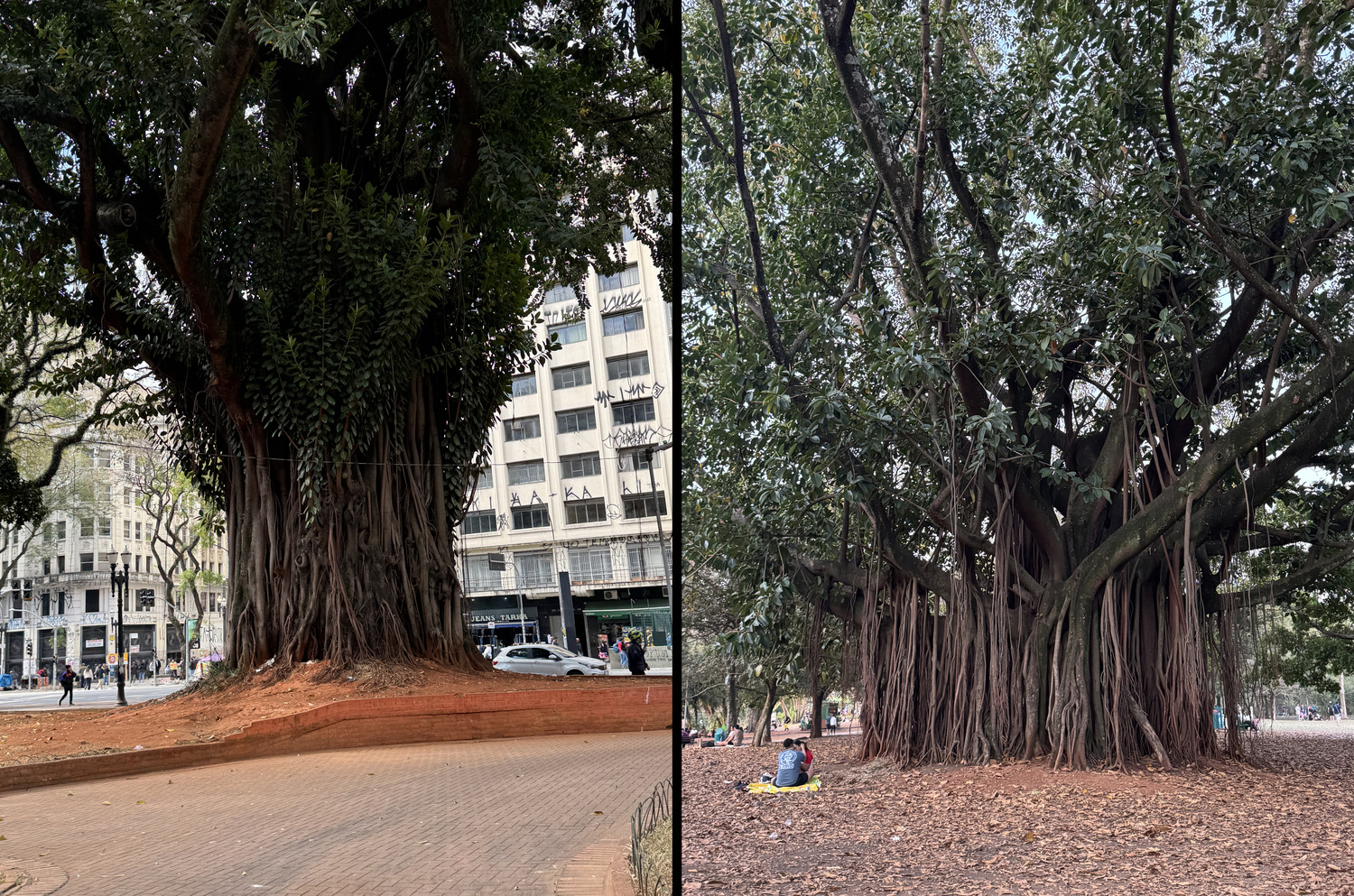
Just to point, but those are not native from Brazil. It's a popular decorative tree, but you won't find them on the wild.
This is a Ficus tree. Is one of the common genus of trees also in the Brazilian rainforest. Some are native. Other not.
For those curious, the world's tallest known living tree is Hyperion in Redwood National Park at 381.3 feet (116.22 meters). https://en.wikipedia.org/wiki/Hyperion_(tree)
On mobile, this website seems to prevent you from pinch zooming in, which makes it slightly inconvenient to quickly zoom into the photos of the trees.
Can do it on Ironfox Android (quite a forbidding browser) without problems. Not even JavaScript is allowed here.
It's to help you learn to recognise different types of trees from quite a long way away.
Number thirty-three: the larch. The larch.
Wasn't sure which kind of trees to expect. :D
I was expecting something closer to Van Emde Boas trees. :D
It's Red-Black Maple Syrup season!
Are you sure the Madagascar traveller's tree is not a camouflaged mobile network antenna?
I remember when a Century Plant just sprouted in my back yard. In the span of a month, it grew 8 meters. It looks very alien in the process.
[0]: https://imgur.com/gallery/what-kind-of-plant-is-this-grew-le...
That was a flower bloom. Also not a tree.
> but you know wood? You know when you hold something in your hand, and it’s made of wood, and you can tell that? Yeah, that thing.
everyone should have a copy of Identifying Wood on their metal bookshelf
There is something fascinating about someone getting a copy of Encyclopedia Brititanica, reading about trees, and then going to Wikipedia for pictures and to fill out details.
Of course one reads a (nice) post like this and must add one's favorite not on the list. Here's mine: https://en.wikipedia.org/wiki/Fouquieria_columnaris
Highly recommend a series on Lodoicea (aka Double coconut or Coco de mer) from the Weird Explorer yt channel: https://youtu.be/GqicsIDYmgU
I highly recommend this 12min video "Trees Are So Weird"
In Calabria — the very south of Italy — there this[0] 1000-years-old plane tree.
This is (was?) the advantage of a printed encyclopedia - one that I've never really been able to replicate scrolling wikipedia. I think it has more to do with the limitations and lack of linking than lack of information (each of these trees has a wikipedia article).
A wikipedia dive session is likely to get more and more specific into trees (attacked by twees!); an encyclopedia flip session is more likely to go across a wide variety of subjects.
In the age of LLMs, it wouldn't be hard to build a UI on top of a Wikipedia dump [1] that satisfied any particular idea of serendipitous flipping.
[1] https://en.wikipedia.org/wiki/Wikipedia:Database_download
A while back I read this book "The Secret Life of Trees: How They Live and Why They Matter" from Colin Tudge and I was blown away by the fact that Mangrove roots effectively breath with the rhythm of tide. As the water recedes, change in pressure and the air is drawn into the pores. As the water comes in, pressure pushes stale air out and seals the pores. Trees are beautiful.
I like to imagine aliens visiting earth and walking straight past us and communing with Pando.
> Recent 2024 analysis confirmed it is at least 16,000 years old, with possibilities ranging up to 80,000 years, making it one of the oldest living organisms.
That would make as much sense as trying to speak with Whales.
What's wrong with whales?
that monolith tree gives me engineering anxiety, you mean all 20,000 shade users are depending on that singleton tree?
And now... No. 1: The Larch
Monty Python?
I expected and wanted tree data structures.
Then you want Foundations of Multidimensional and Metric Data Structures by Samet. Unless you already have it, then enjoy some pretty (organic) trees.
The trees are not unusual at all for the people living in tropical climates. Fun trees Yes but unusual no. Most people of the world live in tropical climates so for most these are not unusual
Let people enjoy things. You aren't contributing to the conversation, you're trying to shit on everyone else for finding something interesting.
Pushing back against the subtle suggestion that only American and European viewpoints are normal is more an example of cleaning up shit than shitting on anybody.
Given where the plurality of readers of this site live (SF Bay Area), the inclusion of the coast redwoods cuts against your argument.