
Stephen's Sausage Roll is my favorite puzzle game. But more interestingly -- it's a near-universal opinion within puzzle communities that SSR is one of the all-time best. I've never heard of such a strong consensus in other subgenres of game.
Unlike other consensus "bests", it's relatively unknown to the public (which is understandable for many reasons). It's very likely that if you're a puzzle game devotee, you will fall in love with SSR; but at the same time, if you don't have experience with puzzle games, you'll very likely hate it.
As a result, I've always thought it's an interesting window into how we value "taste" and "mastery", how too much mastery can actually distance us from one another, and what meaning there is in designing games for an ideal world shaped around ourselves, versus the world we actually live in.
It's well-known that puzzle games sell badly on Steam, and I think part of that is that difficulty and struggle is an acquired taste. Most try to paper over that gap with nice soundtracks and graphics, "hooky" mechanics, and narrative. SSR is so interesting because it contrasts so violently: it's ascetic, has no obvious hook, and offers nothing but difficulty and struggle, and the best feeling in the world if you decide to push through it anyway.
Some of my favorites are puzzle games but I guess I’m not a member of the "community" (is there a message board?) and I’m surprised to hear there's any consensus on anything- my experience has been that most puzzle fans have a very specific subgenre they enjoy rather than enjoying "puzzle games" as a whole. I've had such little luck finding new games I enjoy that I don't pay any attention to puzzle game recommendations u less it reminds me of a specific game I already like. I've played several games in this genre (didn't know it had a name!) and they are very much not my thing.
”Thinky puzzle games” is a specific subgenre and community, revolving mostly around variations of sokoban, but really has an appetite for any game that deeply explores how a few mechanics can be combined and lead to interesting consequences.
Same reaction - I love puzzle games (The Witness, Talos principle, Blue Prince, Myst series, Baba is You, Antichamber, Obra Dinn, Opus Magnum etc), but haven't heard of this. I guess I should give it a try!
Very similar taste in games, and I had heard of it but wrote it off as a simple puzzle game, kind of in the mobile-game-esque throwaway genre. I must have been mistaken.
One of those things is not like the others
No mention of Snakebird in the comments. So here it is.
patrick’s parabox, too
And Void Stranger. I’m surprised not to see it mentioned anywhere in the comments.
It would surely sell more if people would actually explain what the game is, without using niche words like "sokoban". The article talks about how the trailer for it didn't really show anything about the game either, which arguably gets you into pretentious/artistic territory.
After reading the linked article, and the comments here I still have zero clue about the game. It's a puzzle game involving sausages and a large fork does nothing to describe what kind of puzzles they might be.
> After reading the linked article, and the comments here I still have zero clue about the game
A video is worth a thousand words, and there's a video at the very beginning of the article. Did you watch the video?
You control a character on a grid and you have to push sausages around the grid in order to grill them (some of the floor tiles are grill tiles). That's the core game. But the sausages roll and you can't let a given side touch a grill more than once. And the grid is space constrained - you can accidentally push a sausage off the grid and it will fall into an abyss and you have to start over. The puzzles are very difficult because there is so much complexity that stacks:
- Your character can strafe and push things, but your character is also 2 tiles wide and can pivot and swing a fork (and the swing action can push things)
- sausages only roll along one axis, otherwise they slide
- sausages can be stacked into the 3rd dimension which means there's also gravity
- if a sausage falls on your character's head you can move it around and rotate it
- etc.
The game is about rolling sausages over grills to cook them on both sides. However, that's completely unrelated to why it's so acclaimed.
This game introduces a very small set of controls and mechanics (you basically only have the arrow keys, and initially can just move around), and combines it with minimally small, yet surprisingly hard puzzles. Every puzzles is distilled to its smallest form, and involves a genuinely satisfying eureka moment.
The game then explores every possible hidden way to use the minimal set of mechanics introduced, before introducing a new mechanic (e.g. early on you'll be able to suddenly 'stab' you sausages which allows you to move them around differently. So you become a master of the game as you progress.
The problem for new players is that it's deceptively difficult to solve even the simplest puzzles + it encourages you to explore and learn how things work instead of giving you hints. This makes inexperienced players abandon it way before it fully reveals itself (which takes many hours into the game).
What I suggest is if you are new and are frustrated, find a Youtuber that solved it so that you can look at what they did. This way you won't get stuck to the point of leaving it, while still allowing you to fully enjoy it.
The problem is, the ways that it's great are hard to put into words and explain for someone unfamiliar with the game. At least, not in a succinct way. At the most basic level it's just block pushing puzzles ("Sokoban").
Sokoban is a common word within puzzle game fans and devs. That article wasn't written for people that didn't like those kinds of puzzles in the first place.
> It would surely sell more if people would actually explain what the game is, without using niche words like "sokoban".
Sure, sure. Here's the annotated second paragraph from TFA:
When game designer <Stephen Lavelle> [0] (Increpare Games) released Stephen's Sausage Roll back in April 2016, it was accompanied by <a trailer> [1] that showed almost nothing about the game, yet word still spread quickly. Puzzle developers and fans praised the game for its impeccable design, teasing out layers of deep puzzling and mind-expanding discoveries from so few puzzle elements. It was also renowned for its uncompromising, yet always fair, difficulty curve, with immensely challenging puzzles from the very start. These sentiments are still held to this day, as this beloved sausage-pushing sokoban continues to influence new generations of puzzle developers, <inspiring some of the best sokoban games> [3] ever made and introducing "Sausage-likes” to the puzzle vernacular.
Sokoban games, also known as block-pushing or box-pushing games, are turn-based puzzle games in which you control a character pushing or moving objects around on a grid. The genre has origins in the 1982 game Sokoban, designed by Hiroyuki Imabayashi, in which you have to push boxes around a warehouse onto designated targets. The japanese word 倉庫番 (“sōkoban”) translates to “warehouse keeper”.
Learn more about Stephen's Sausage Roll in <our database of thinky games> [4], where you can also find <similar games> [5] and some of the <best sokoban games ever made>. [3]
[0] <https://increpare.com/>
[1] <https://www.youtube.com/watch?v=lCNqYLGwqxU>
[3] <https://thinkygames.com/lists/best-sokoban-games/>
[4] <https://thinkygames.com/games/stephens-sausage-roll/>
[5] <https://thinkygames.com/games/stephens-sausage-roll/similar/>
Almost anybody who grew up with video games in the 80s played Sokoban and knows exactly what that refers to. It was THE puzzle game in the early days of video games... that and maybe millipede.
I only know what "sokoban" means because of the sokoban levels in NetHack.
So is there any way to explain it to the people who grew up in the half century since then?
Puzzles involving pushing blocks around a grid, where most of the challenge comes from the constrained motion. Blocks might get stuck if you push them into a corner, for example. It might be necessary to move things in a certain order, which isn't obvious at first.
"Sokoban" translates to "warehouse keeper". The original game was about moving boxes around in a crowded warehouse.
Sure, though they're already familiar with it too.
https://images.squarespace-cdn.com/content/v1/5758783607eaa0...
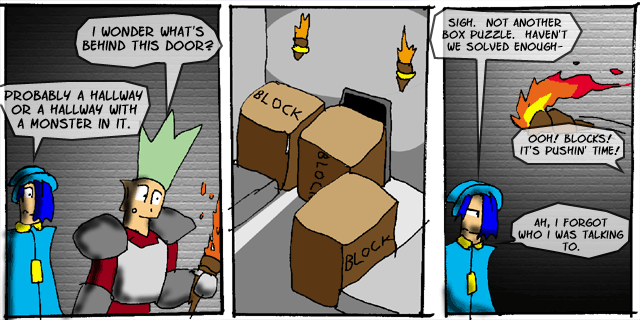
https://tvtropes.org/pmwiki/pmwiki.php/Main/BlockPuzzle
Complaining that games may be described as "like Sokoban" is kind of like complaining that they might be described as "real-time strategy".
> It would surely sell more if people would actually explain what the game is
And even more if figuring out how to buy it wasn't a challenging puzzle in its own right.
Let me DGG that for you. Even dgg got this one right the first time!
https://store.steampowered.com/app/353540/Stephens_Sausage_R...
On sale for 6$ at 80% off.
Stephen's Sausage Roll is great, but even among sokobanlikes, I'm loathe to call it the undisputed all-time best when it's up against Baba Is You.
Overall, I probably agree that Baba is You is a better game, but I think what makes Stephen's Sausage Roll receive so much praise is that the puzzle design is incredibly tight. It's a very straightforward concept and the core mechanic does not change between the first and the last level. But the puzzles are expertly crafted in a way that as you progress through the game you naturally come across situations where you think you know everything about the game and then it surprises you with a new mechanic that you did not expect.
Baba is You ramps up as you go to, but the ramping up is mostly done by the game giving you new tools to work with. Plus, the amount of interesting puzzles you can do with the mechanics of Baba is You is virtually endless, whereas SSG makes you feel like the game squeezed all the possible gameplay out of moving sausages around.
SSR walked so Baba could run
In favor of SSR: The design is more vertical than Baba, it explores fewer mechanics but with greater depth. And it's entirely spatial, whereas Baba's solutions are sometimes a matter of wordplay, with the sokoban just a formality.
I like Baba better, but I'm not sure if it's the better game.
> SSR walked
rolled, surely
I'll take Portal over it any day of the week
I love Portal, but it feels more like a tutorial than a puzzle game, because the tolerances on each solution are so large.
It's a fantastic game, one of the all-time greats, and there are tricky parts to execute, but it's not particularly challenging in terms of puzzling.
Portal is incredibly basic in its puzzles. There's barely any challenge even in the second game. Stephen's Sausage Rolls pushes its basic mechanics to the absolute limits and made me think significantly harder than Portal ever did. Not that Portal is a bad game mind you but it's not very deep as a puzzle game
what are some other games that belong to this group?
I always felt Deadly Rooms of Death (my preferred version being the free "Architect's Edition", but all are good, and many have better QoL features) was one of the puzzle games which was essentially "discovered" rather than invented.
Simple turn-based eight-direction grid movement, where one of your adjacent squares contains your "sword" and you can rotate your sword around yourself one square per-turn. Kill (deterministic and 1hp) monsters by moving your sword on to all the monsters move after your move, and "complete" a room by killing all monsters.
There's quite an active community (at least there was when I was in to it) but I've rarely heard it mentioned outside of the community.
Edit: I'm happy to see some other references to DroD in this thread.
A Good Snowman Is Hard To Build and A Monster's Expedition are games in the same genre with much better presentation than Sausage Roll.
All of the critically acclaimed puzzle games seem to be sokobans. I have no idea why sokoban is so popular; I find it very tedious to move blocks around manually, especially if I already know the solution and I'm just making it happen. For me games like Artisan of Glimmith, LOK Digital, Tiling Town and Lingo are the most fun, followed by deductive games like The Roottrees Are Dead and The Case of the Golden Idol.
>All of the critically acclaimed puzzle games seem to be sokobans
Wouldn't really agree considering:
Antichamber, The Witness, Talos Principle, Manifold Garden, Portal, Zachtronics, Tunic, Blue Prince, Return of the Obra Dinn, Seance of Blake Manor, a bunch more I could list.
Tunic is such an incredible experience. If you ever enjoyed the original Zelda and its manual, you simply must play tunic. It captures something incredible. And it has some amazing twists.
But it's hardly what I would consider a puzzle game.
You could consider it a jigsaw puzzle game.
I'd say it's either an action-adventure game with some mystery, or a mystery game with some action-adventure, depending on the player.
Exactly, I am quite surprised by this thread. I always thought sokobans were just one of the niches of puzzle games (one that I am not quite a fan of, to be honest... I find it just okay.)
This one is critically acclaimed and is not a sokoban: https://store.steampowered.com/app/2721890/oo/
A good sokoban should not be busy-work. Well designed puzzles should be pithy and not require a lot of running around. The distance between discovering the solution and executing it should be very short.
That must be a specific niche. I enjoy puzzle games and the only sokoban game I can think of is Baba Is You. Though many games, including games that are not primarily puzzle games have a sokoban-like puzzle at some point.
The puzzle game that reaped all the rewards this year is Blue Prince, it has its sokoban moment, but as a whole it is definitely not a sokoban game.
The Artisan of Glimmith is so good! Biggest surprise of the year for me so far.
Not surprised, he’s a friend whom I watched build the game over a few years in the 2010s. He was EXTREMELY thorough in the playtesting, it set such an unrealistic expectations for me with games I play now
My list of must play puzzle games is far too short: Portal, Portal 2, Demon’s Souls, and Baba is You. It’s amazing to me that I’ve never heard of a game this lauded.
I can recommend Void Stranger. Real mystery box of a game. The first ending seriously hooked me into figuring out all its secrets.
Prepare yourself to get inundated with recommendations. Antichamber, Tunic, Talos Principle, Blue Prince, Return of the Obra Dinn, Outer Wilds, Superliminal, literally every Zachtronics game (most especially Opus Magnum)...
I don't think I've ever heard of Demon's Souls being categorized as a puzzle game. I suppose some of the bosses have a trick to figure out? But I'd still think it falls into the action RPG genre by a wide margin.
Perhaps modern AAA games have become so handholdy that any game that shuts up long enough to allow the player to experience a sense of genuine exploration and wonder counts as a puzzle game, in which case I'd recommend the rich genre of indie Kings Field-likes, e.g. Lunacid. A bit further out would be something like Moonring (Ultima-like) or Caves of Qud.
Not OP, but I've had the same conclusion. It's a bit cheeky to call it a puzzle game, but I don't think it's strictly wrong.
Imo it's better to approach Demon's Souls as an exploration puzzle game with RPG stuff and combat, not as an action RPG (such as Dark Souls 3).
It's a puzzle maker's puzzle game. The reason why it's so lauded is because the design is so tight. Kinda like how there's certain buildings the public thinks is ugly, but architects all like it because it tickles that part of the architect brain. It's a game that gives you that ah-ha moment. Kinda that moment where you walk from the forest into a clearing, but for your brain.
The game is hard. I only kinda got the hang of it, and I didn't quite get to that ah-ha moment. You have to be willing to sit with it and think. I think with sokoban games, you can often just almost random walk your way to a solution, because the state space and its transitions is easy enough to wander into. But I didn't find that to be the case with SSR. You have to be able to reason about the state space changes, I think because the state space isn't exactly euclidean, so it's harder to wander into the solution.
No "The Witness"? Not incredibly challenging, but I very much enjoyed its blend of puzzling and aesthetic.
"The Witness" was fine but I found its overly pompous philosophizing unbearable and pretentious. Rather play "Taiji" instead, which is clearly inspired by TW, but without the grandstanding, and at least IMHO, the puzzles are also better.
I find TW to be excruciatingly boring.
Personally, I had wanted a new Myst, and The Witness wasn't that, and so I was a bit disappointed. Obduction was released a year or two later and it was similar to the Myst I remember from my childhood and it was also a good game. I strongly recommend it.
That said, The Witness isn't a bad game as such, though the puzzles do get a bit repetitive in my opinion. I prefer more variety rather than hyper focus on one type of puzzles.
For me, Outer Wilds finally got the Myst feel right.
Interesting, I had passed it by when I heard it had a time limit and reset mechanic (not unlike Zelda Majora's Mask). I hated that mechanic in Majora's Mask (and I never finished that game), it made the game feel stressful to me.
I prefer games where I can play slow and deliberate. If there is a time mechanic it should be turn based, not real time. (Or it should be a very short time based system such as "run across the room to hit the other button, the cost of failing is 10 seconds of trying again, not 10 minutes".)
I would normally agree with you about time pressure, but Outer Wilds worked for me even so. In Outer Wilds I found the time loop liberating.
By construction, nothing in the game is far away. You're only limited by how much you've figured out. And having the spark of understanding occur can take place at any time, including while you're away from the keyboard.
So it's mostly about following your curiosity wherever it leads you, and from there you keep digging all the way, safe in the knowledge that in 22 minutes at most any screwups will be rolled back. And then you can try again, or, better follow your curiosity somewhere else. There's no lack of things to figure out, and some of them are completely optional. But... Figure them out anyway, the reward is worthwhile.
"Thank you for remembering me."
Outer wilds definitely has stressful parts (it is also a horror game even though it doesn't wear the normal aesthetics of one), but generally the time pressure is not a major issue: the game even pauses while you're reading text so you can mull over things at your own pace.
I know exactly what you mean by Majora’s Mask. Ugh. I spent all that time getting here and now I’m out of time and it resets?!
I can see why Outer Wilds might feel the same way. But somehow it didn’t for me. Probably because it really doesn’t take much at all to get right back to where you were.
Try the RHEM series. It's Myst, but harder, complete with slideshow of late 90's 3D graphics environment. I liked Obduction, but I found it a bit too easy.
Have you tried Blue Prince? It's got some similarities (it's basically Myst + a spatial puzzle + modern drafting/resource management board game).
And you don't have the time element of Outer Wilds (Outer Wilds is brilliant though, and it kinda needs that time element to work properly).
I mean technically it does in that you only have so many steps in a day, but you only spend a step moving from one room to another, so you can take your time in any given room, and you have ways to increase those steps.
Also you're more likely to block yourself off with your room layout for the day than you are to run out of steps, at least once you start getting better at the game (it can happen though).
Might as well add The Talos Principle then
The witness was fine, but The Looker was much better.
I think The Looker might appeal both to those who loved The Witness and those who didn’t. Several laugh-out-loud moments, some fun puzzles of its own - a wonderfully silly send-up, and free, too.
Routing games like Mini Metro/Motorways, Freeways, and Fly Corp are not quite puzzle games in the traditional sense, but I'd definitely encourage any puzzle fans to try them.
if we're going to plug random puzzle games on this thread, IMO the most underdiscussed puzzle game of all time is Recursed, the only game i've played which properly explores recursion as a mechanic, and (MINOR SPOILER) the only game i've played which detects when you have created logical contradictions, and for each contradiction you achieve rewards you with a secret bonus level.
Recursed is really fantastic. There's puzzles in there that took a few days for me to solve
If we're talking about recursion, Patrick's Parabox is another stellar pick.
Little known, but a warm recommendation, both for the puzzles and atmosphere: The Swapper. (disclaimer: I did some coding work for this game)
Give "Please Don't Touch Anything" a try.
Demon’s Souls???
I guess Zelda, Metroid and Half-Life also count as puzzle games then. :)
Metroid, Half-Life, and Demon's Souls I would take issue with, but I've always considered Zelda a puzzle game, and I never questioned it until now.
I suppose the new Breath of the Wild / Tears of the Kingdom titles are more action-oriented, but everything in the mold of Ocarina of Time is a puzzle game with some light combat sprinkled on top.
I was being a bit silly but the Souls series do have a metroidvania angle to them. Also each enemy, especially the bosses, are small puzzles where you figure out how they work and then how to overcome them.
Dungeons contain mainly puzzles, but otherwise it's a lot of combat and story and side quests, similar to most RPGs.
But the overworld missions are basically all puzzles! I don't think there's more combat in the overworld than in dungeons.
Well Zelda games consistently feature block-pushing puzzles so I guess Baba Is Zelda.
accidentally makes PEACH IS FORT
Sorry Mario, but your princess is another castle!
For another niche hit check out Recursed
As a British person, this is confusing since the game doesn't involve a sausage roll!
The developer is also British; it's a pun because you roll sausages in the game.
I believe he is Irish.
My bad, it appears you're right, an Irish national based in London.
I wish that Opera Omnia, also by Stephen Lavelle, got more attention. It is mind-blowing exploration of the idea of propaganda and revisionist history, which somehow also manages to be engaging and fun, with an incredibly unique core mechanic.
https://www.increpare.com/game/opera-omnia.html
This one? It looks interesting but definitely a lot less visible than SSR and not on storefronts or etc, right?
No shade thrown, but I always preferred my game with some amount of story or artistic ambition beyond mere puzzling.
I'd take Void Stranger or probably even Deadly Rooms of Death: The Second Sky over Stephen's Sausage Roll any day, I imagine.
If you or anyone else reading this haven’t finished Stephen’s Sausage Roll to the very end, including reading all the story book paragraphs along the way (which increase in poignancy and frequency as the game winds to a close) then I strongly encourage you to do so. No spoilers!
de•li•cious saus•ag•es
I love pure puzzles and completed SSR. The story consists of sign plaques that narrate the history of the fictional world, and how your player character fulfills their place in the world through the main goal of cooking sausages. A bit unique and interesting, though not particularly complex, and you can guess the twist before it reveals. In other words, a puzzle game with a short story interspersed, perhaps 99% puzzles and 1% reading. The music consists of relaxing algorithmic ambience. The artistic ambition aims for surrealism and minimalism. I like it a lot, but I recommend against it for you.
Deadly Rooms of Death is criminally underrated and generally unknown. Journey to Rooted Hold is personally my DRoD of choice.
Everyone’s different.
I’m good with zero-story puzzle games. I’ve spent many hours in Simon Tathem’s Puzzles [1] on my iPhone, just for the 100% pure logic goodness that they are.
[1] https://apps.apple.com/us/app/simon-tathams-puzzles/id622220...
Do yourself a favor, if you haven't yet: go in the instructions for the games you like and find out the original game's name (for example' "Light Up" is actually called Akari), go online and find hand-crafted puzzles for that game. I love that Simon Tatham's Puzzles exists, but nothing beats hand-crafted puzzles made by good designers. There's a sense of purpose in the order you discover the solution and some "eureka!" moments that randomly generated puzzles will never give you!
you might want to have a gander at https://store.steampowered.com/app/207570/English_Country_Tu... (there's a mac/iphone[0] version, not sure if it still works on newer versions of macs tho).
[0]http://itunes.apple.com/us/app/english-country-tune/id476962...
Yeah same here. I love puzzle games but there needs to be something to it besides puzzles for puzzles sake for me.
I've seen this game recommended many times but I've never played it because I feel like I would get bored very fast. Same with Zachtronics games.
i so badly want to spoil the story of stephen's sausage roll for you. i feel bad even spoiling that there is a story. play it.
If anyone enjoys snarky long videos critiquing games, they might enjoy Joseph Anderson's review of this game: https://www.youtube.com/watch?v=6dsQtBHk0eE
FYI it's on sale on Steam today: $5.99
I recently watched "A Course on Puzzle Game Design" by Matthew VanDevander and he mentioned Stephen's Sausage Roll a few times.
https://youtu.be/85mAmP4k1Co?si=yuxpJ2xhkH7r_eo3
The video has lots of helpful information for puzzle game design. I have started to incorporate some of that knowledge into my own puzzle game https://qcgeneral29.itch.io/lets-learn
I completely understand how this game is brilliant and a perfect puzzle game. But it was so hard and frustrating I could not play it.
> most influential puzzle games ever
Never heard of it.
Good sokoban, but maybe my fastest rage/impatience quit on a puzzle game at 10-ish hours. I find it too difficult.
This is more or less my take, but at least for me it's not about the level of difficulty exactly. It just feels very transparently like exploring a state space, where the "a-ha" moments just boil down to breaking into a different neighborhood of that space. To be clear, the puzzles are very well designed, and also very hard; but I don't find solving them satisfying at ALL. Compare with Baba Is You, where the "a-ha"s feel to me more like having a grand insight than finding the right very specific sequence of moves.
Put another way, it's been years since I played Baba and I can still remember the key insights to some of the sneakier puzzles. I couldn't even begin to do that for SSR.
That's my verdict on Stephen's Sausage Roll too. My personal favorite sokoban is Patrick's Parabox (the name is an obvious nod to SSR) because its puzzles have a gentler and finer-grained difficulty ramp.
Kula world was and always will be my favourite of these sort of games. Simple yet really challenging.
It's a perfect game.
Is this what Jonathan Blow is trying to copy with Sinking Star?
Trying to copy is a bit harsh, but he has credited it as an inspiration for what's possible within the Sokoban format. I believe he was a playtester for SSR before it released, mid The Witness development.
Oost does incorporate elements that were tried in a puzzlescript game “mirror isle” and sean t barret’s “promesst”. Dont think anything directly from this sausage one.
Not sure, but Sinking Star it is an (authorized) amalgamation of pre-existing sokoban games so there's some relation there.
From this post by one of the original devs: https://bsky.app/profile/draknek.bsky.social/post/3m7qybidq7...
Perhaps a more direct relation: most of those preexisting games were made in puzzlescript, which (per the article) was also made by the author of Stephen’s Sausage Roll.
Blow originally did Order of Sinking Star as a quick side project. He thought that by using these pre-existing games as a starting point, he'd get it done quicker. But then he decided to experiment with the combinatorics of these mechanics that the game blew up so much in scope that the original starting point didn't help at all.
Copy, certainly not. But Blow was an enthusiastic promoter of the game when it came out and held it out as a standard of excellence in puzzle game design.