
> Me: "I don't like smartphone UIs. Everything is flat, nothing indicates where you can touch or not. I have to randomly try everything on the screen."
Response by non-tech person: "Well, yeah, of course you have to try everything? How else would this work?"
I think this goes deeper than many tech people realize.
From what I understood from talking with "nontechnical"(*) friends, relatives, etc, for a good potion of them, computers had always been "unpredictable magic". They got by through memorizing some very strict and rigid interaction sequences - "click this icon, then click that menu, then click that button, etc" and prayed nothing unexpected would happen. They were too scared and/or uninterested in computers to even try and find any rules or consistency in it.
I feel as if those nontechnical people "won" now. Now all UIs feel as inconsistent and unpredictable even for "techies" as any computer interaction felt to those people back then.
(* repeated from another thread: "nontechnical" in the "not fluent with PC use" sense, which is actually quite arrogant - they can have very high technical skill in other areas obviously)
I've witnessed this so much over the years. Much of the time when someone would ask me for help with something on the computer, I would have no idea, but I could discover the answer with a little bit of exploration and a good understanding of how UIs are supposed to work.
Windows 2000 was peak Windows UI, and everything since then has been worse.
Then Microsoft started thinking it was a good idea to make native applications look and work like webpages, which was a huge step backwards. Fortunately, that stupid idea didn't last too long, but it did have some lasting effects like the advent of "flat UI" style, but it was the beginning of the modern era of flailing around trying to improve on something that didn't need improving with one bad idea after another.
These days, I sometimes find that _I_ cannot figure some things out in software like Outlook or Teams that should be obvious because there are so many different styles of UI in these tools, many of which are not very intuitive or discoverable. Mixed metaphors, style over substance, and the idea that "flat" is anything but a way to turn your display into a sludge of rectangles of slightly different shades of grey with little or no differentiation between them, and few or no visual cues as to what elements of windows are clickable.
There are certainly things that are better now, like the popularity of "Dark Mode" which took about 30 years too long to happen, but in general, I don't think UI is better than it was 25 years ago, especially after Microsoft wasted 5 years or more on the absolutely misbegotten idea that computers should look like phones. Of course, the legacy is that Windows still has the remnants of about 5 different styles of UI in different places, and I wouldn't be surprised if there weren't a few Windows 3-era UI pieces still hanging around the Control Panel.
> They were too scared and/or uninterested in computers to even try and find any rules or consistency in it.
Yes, and this is still true today. I work for a company with a large very non-technical user base. People absolutely will not explore, click on things outside of what they have memorized, or even try basic troubleshooting steps out of fear of breaking things.
It's actually really frustrating when trying to train to certain software or concepts because you have to lay everything out very explicitly, step by step. You cannot leave anything to the imagination or just assume that because the UI is "intuitive" that they will figure it out, because they won't even try.
I've encountered some form of that attitude and behavior at nearly every job I've had.
> People absolutely will not explore, click on things outside of what they have memorized, or even try basic troubleshooting steps out of fear of breaking things.
I agree with this in general but it can be tough for financial/business/order workflows where an irreversible change may be initiated. From the software perspective an audit log or Git-like history would easily mitigate these concerns but they usually don't exist. And "non-technical" users often just want to "know what buttons to click" to do their job.
To the point of the main article don't think I ever had the opportunity of using Windows 2000. Remember jumping from 98 to XP? Not sure about ME/Millennium either and if it's the same or a variant of 2000.
> From the software perspective an audit log or Git-like history would easily mitigate these concerns but they usually don't exist
Yeah, and this is definitely a big reason why people are afraid to click and explore.
I still don't understand why big enterprise software still lacks any kind of version control. AUdit logs, yeah, but most big ERPs and other similar products don't have an easy "roll back this change" feature.
I think users knowing that they could immediately undo whatever they did and get back to a safe and known state would do a lot to encourage exploration and learning.
Not the same. ME also came out around 2000 but was based on windows 9x, windows 2000 was based on NT. The UI looked somewhat similar with those two.
> You cannot leave anything to the imagination
I don't know if there's ever going to be a suitable environment to have this conversation, but many people in any society are just not smart enough to experiment with things especially if those things are non-physical or abstract.
My parents never had any problem understanding where they can click on Windows 3.11. They never could understand how to interact with DOS GUIs.
Nowadays they have decades of experience with computers. They still can't predict what part of a web-site they can interact with, but they have memorized all the actions they can make on the phone apps they use.
My mother learned BASIC in college (not at all proficiently though), searched the web before the era of Google to learn about my sister's medical condition, and has used technology to enhance her teaching (when it actually helps) whenever she can, including trying to learn OBS during COVID to better teach remote classes, but when Windows Vista came around, she had to ask "What do I do?" to open her program.
Because Microsoft, after spending millions to recognize that labeling the button "Start" was brilliant, removed that label.
There was no justification for abandoning the millions of dollars of research that multiple computer companies produced for good UI design decades ago.
It was all just thrown away because some design asshole somewhere wanted to swing their dick around.
Millions of the same people who had no issue migrating from Windows 3.1 to Windows 2000 systems have been fucked over. People who knew how to use computers were given a huge middle finger at everything they learned. They were handed a system that was objectively harder to use than the previous one.
For some "designers" wet dreams.
People are bad with computers because "Designers" have been objectively value negative for decades. Instead of paying attention to the reams of scientific data that tells you exactly how to make a UI better, they smoke crack and make things transparent.
Clear buttons with obvious intent have been replaced with a goddamned inscrutable "Hamburger" menu. Decades old metaphors and systems that made sense to people who were born before computers were abandoned. Reliable and predictable functions that you could trust across applications have been eschewed in favor of hacked together javascript trash that screws up basic things like scrolling and copy/paste and drag and drop. Even though such functionality is often provided directly by the browser, they override it and fuck it up.
And people call these idiots "The best of the best"
Let’s look at the very website we on. Would you prefer for every clickable element here to be a button? Or even underlined as a link? Do you ever get confused navigating this website?
> Would you prefer for every clickable element here to be a button? Or even underlined as a link?
Yes.
> Do you ever get confused navigating this website?
No, because I've been browsing the web for a while and know that every website does things their own way.
Given it’s a website mostly for experienced computer people who, like you, don’t really need those visual cues, don’t you think adding them would be superfluous?
No.
It's a website for experienced computer people, and I appreciate its minimalist aesthetic, but that doesn't mean there's not enormous room for improvement.
Now that you've said it, I think PG would have designed a better site if he didn't hide the underlines.
But also, it wouldn't get any worse if the same design was kept and the underlines were enabled. And it would improve the usability for first-time users, but the nature of HN is that those are always very few.
I have recently discovered a config option "Underline all links" in Firefox, and it's really nice, actually.
Wouldn't hurt if interactive elements didn't require me to zoom in order to interact with them on mobile.
I live in regular fear that my fingertip will hit the wrong up/down icon.
I often forget you can click on the timestamp. In fact for years I didn't know how to flag comments because of this.
The goal of human-computer interaction is to make accessible software that is intuitively easy to use for the most people. We need to make this mandatory in CS education (again).
It started with iOS 7 and Jony Ive
Steve Jobs was right. Then when he died (after removing Scott Forstall), Jony Ive got to do his hardware minimalism in software too. And everything Steve Jobs favored was suddenly derided as “skeumorphism”. It’s like what USSR did with Stalin under Khrustchev. I still remember when Chrome app just had a big white area where you’re supposed to enter the url and you had no idea unless you randomly happened to click there. And if the website background was white, too? Oh too bad LMAO. Minimalistic! Chrome had no… chrome.
I don't remember when I first encountered it (maybe before ios7), but their cardinal sin for me was my struggling for 10 minutes to make the calculator app go into scientific mode, seeing absolutely no setting for that, before eventually discovering from a friend that you have to physically rotate the phone to landscape orientation to get the additional buttons.
That reminds me of that notorious story of the adventure game from the 90s where you had to make a fake mustache out of cat hairs to solve a puzzle.
Gabriel Knight 3: Blood of the Sacred, Blood of the Damned.
I was happy to find this Wikipedia article https://en.wikipedia.org/wiki/Cat_hair_mustache_puzzle
Windows 8 was released a whole year before iOS 7, so the blame here is misplaced (though I won't argue that Ive's approach to UI design was worse than what came before).
Jony Ive is a plague on design. Just a few days ago someone showed me Ferrari's new EV that he designed. I am not a car person and even I can see it looks like crap! That man should just take his big Apple money and fully retire so he doesn't ruin anything else.
> Since that button down there is called "Start", it implies that you can probably do something with it, maybe start programs? Click and you'll see the Start Menu:
Over time it seems like a lot of designs stop feeling the need to lead the user in this way. There is an assumption that by now everyone knows what the menu in the bottom left corner does, and we are no longer in the phase of trying to teach the population to use a computer for the first time.
I feel like this is the wrong approach. Every day there are new young people using a computer for the first time. Wouldn’t it be nice if all these conventions that evolved over the past 50 years could be intuitively discovered, instead of needing explanations from someone who already understands them?
Of course, as the world becomes more digital, many skeuomorphic designs become more abstract to those same young users. The floppy disk, the traditional telephone, even the file folder.
I was a wee little kid when I first touch windows 95, and only ever used dos before.
The "Start" button made no sense. The computer was already started, and clicking randomly popped up menus and opened documents in their right programs, so it felt like the natural way to progress. The owner of the computer had to point me to the start menu.
Even now I still think it was a cursed UI. It was the place primarily to close and shutdown the computer (again, when you see that button the computer and OS will always be already started), get to the control panel or run commands. None of it felt like "start", and the current windows logo only design makes a lot more sense.
To your point, small kids get proficient very fast with smartphones and iPads. I'd call their interface a lot more "intuitive"
I never liked the word "start" itself, but if you're going to have a GUI, a single central clean place to say "every interaction you may want to do can be found from here" is a good idea. In principle having search there is pretty useful.
In practice Microsoft has consistently from the beginning gone out of their way to make the search useless and slow, a policy that is now old enough to vote. How the start menu has now gone nearly two decades without you being able to type "note" and see Notepad just pop up as one of the choices instantly beats me on my ever-more-super super computers, but that's an implementation detail that Microsoft has consistently botched. And more and more over time, Microsoft has thought more about what they want in the menu than what the user wants.
Nevertheless, the general idea of that top-level "here's everything" is a good one. The open source desktop environments do a much better job with it, without marketing trying to figure out how to stuff this half-decade's marketing push on to the user or "monetize" it.
> And more and more over time, Microsoft has thought more about what they want in the menu than what the user wants.
This pretty much describes _everything_ in Windows in the last 15 years.
The Windows 95 UI designers wrote a paper going over their design methodology and how they incorporated feedback from real-world users at a variety of levels of computer proficiency into their design. https://dl.acm.org/doi/fullHtml/10.1145/238386.238611
For example, the reason for the single "Start" button in the taskbar was that they initially had multiple buttons for different specific purposes, and relied on a "Programs" folder on the desktop for launching programs, but found that this design didn't hold up in testing:
> Users had considerable difficulty deciding what each of the three buttons on the Tray was for and later had trouble remembering where to go for a particular command because their functions overlapped in certain contexts (e.g., to find something in Help, do you go to Find or to Help?).
> Users of every type were confused by the Programs folder. We thought that having a folder on the desktop with other folders and links to programs inside it would be a natural transition for Windows 3.1 users accustomed to Program Manager, while being relatively easy to learn for beginners. We were wrong! Beginners quickly got lost in all of the folders and other users had a lot of trouble deciding whether they were looking at the actual file system and its files or just links to actual files.
> The results from these studies and interviews greatly changed the design of the Windows 95 UI. In the early Windows 95 prototype, we had purposefully changed some things from Windows 3.1 (e.g., the desktop was now a real container) but not others (e.g., File Manager and Program Manager-like icons on desktop) because we were afraid of going too far with the design. We were aware that creating a product which was radically different from Windows 3.1 could confuse and disappoint millions of existing users, which would clearly be unacceptable.
> However, the data we collected with the Windows 95 prototype and with Windows 3.1 showed us that we couldn't continue down the current path. The results with beginning users on basic tasks were unacceptably poor and many intermediate users thought that Windows 95 was just different, not better.
As a kid who started on Windows 3.1, the 95 Start menu made so much more sense. It felt revolutionary.
> There is an assumption that by now everyone knows what the menu in the bottom left corner does
Except that... it's no longer in the bottom left corner! Recently, I had to help a relative with a Windows system, and what passes for the "Start" button has now moved to somewhere more in the center (and, of course, this completely confused my relative, who was used to the old place). I also had to rant about Fitt's law (without mentioning its name) and how things were better the way they were before. And I also had to find out and show them where the shutdown button ended up this time, so they could power off the computer normally (as they were used to) instead of having to use the power strip switch.
And the issue I had to help with? Windows was too slow (to the point of nearly unusable). They don't use the computer often (and obviously always power it down after each use), so it's always running some heavy background update (on a mechanical hard drive) whenever it boots up. My advice was to power it up and let it sit for about an hour before using, then it would be back to normal speed.
You could've changed the setting that puts the button back on the lower left corner and saved your relative the trouble.
The new default is truly terrible, though, and this was the first setting I had to change when I was forced to use a windows laptop by the company I work in.
The new iOS beta buries the “share” button under the line button inside the search lozenge, which was previously for view settings (and downloads). The iOS design team is just coasting on good decisions make a decade ago. The only good things are stuff they haven’t gotten around to fucking up yet.
I also think about this, and worry about this. My go-to example is that the file-system in Windows used to clearly be a tree, and the file explorer was how you traversed this tree. With "Libraries" and other shenanigans with the location of the Desktop folder, it's not much of a tree anymore, and I wonder if this is related to kids-these-days not understanding the basics of file systems anymore.
https://www.theverge.com/22684730/students-file-folder-direc...
I think smartphones obscuring the filesystem away, and desktop search making the skill less of a requirement really hurt the filesystem understanding for younger generations.
I remember Steve Jobs saying the last area of complexity they needed to be solved was the filesystem, which is why they made the iPhone the way they did, with apps owning the files, so users didn’t have to deal with it. We’ve seen the Files app introduced and those walls get broken down, so it was clearly the wrong approach, especially when various apps can all perform actions on the same type of files.
Jobs also said death would take care of the problem of people not knowing how to type. I often think he should have taken the similar approach to the filesystem. Required learning for the modern era, not something to hide away so skills never develop.
> Jobs also said death would take care of the problem of people not knowing how to type. I often think he should have taken the similar approach
I was all set for this dark humor, and actually had to double back to then understand the full sentence.
This to me feels like an example of Microsoft poorly copying (a bad feature from) Apple.
> There is an assumption that by now everyone knows what the menu in the bottom left corner does, and we are no longer in the phase of trying to teach the population to use a computer for the first time
Strong disagree, because:
> Every day there are new young people using a computer for the first time
I can assure you these people have no idea what the start button is or does... it doesn't help that it no longer even says "Start" for the last ~20 years.
We do agree. I said the first thing you quoted was the wrong approach, because of the second thing you quoted. Having it say “start”, like it used to, would help solve that.
For people complaining that "Start" isn't a great choice, perhaps there's something better, but I can't think of anything. You need a small word that implies, "Click here to do something or find something." and in that regard, I think "Start" is a good choice.
On the other hand, I think there were few ideas worse than "My Computer", etc., not the least of which is the fact that it took Windows application software about 10 years to get consistently good at handling paths with spaces in their names.
Of course, the worst UI thing Microsoft ever did was hiding file extensions by default. That might be the worst UI decision in all of history.
> That might be the worst UI decision in all of history.
The Windows 8 touch-first start menu with a hot corner instead of a button, applied to their Server OS, that I assume most accessed through RDP was pretty horrific.
Ok but, were you around during that time? I remember it not helping much at all to tell people what to do.
When Windows 95 first came out, they had to have a giant arrow pointing to the Start menu with an explanation of what that would do: https://a.imagem.app/Ge6OCZ.jpeg
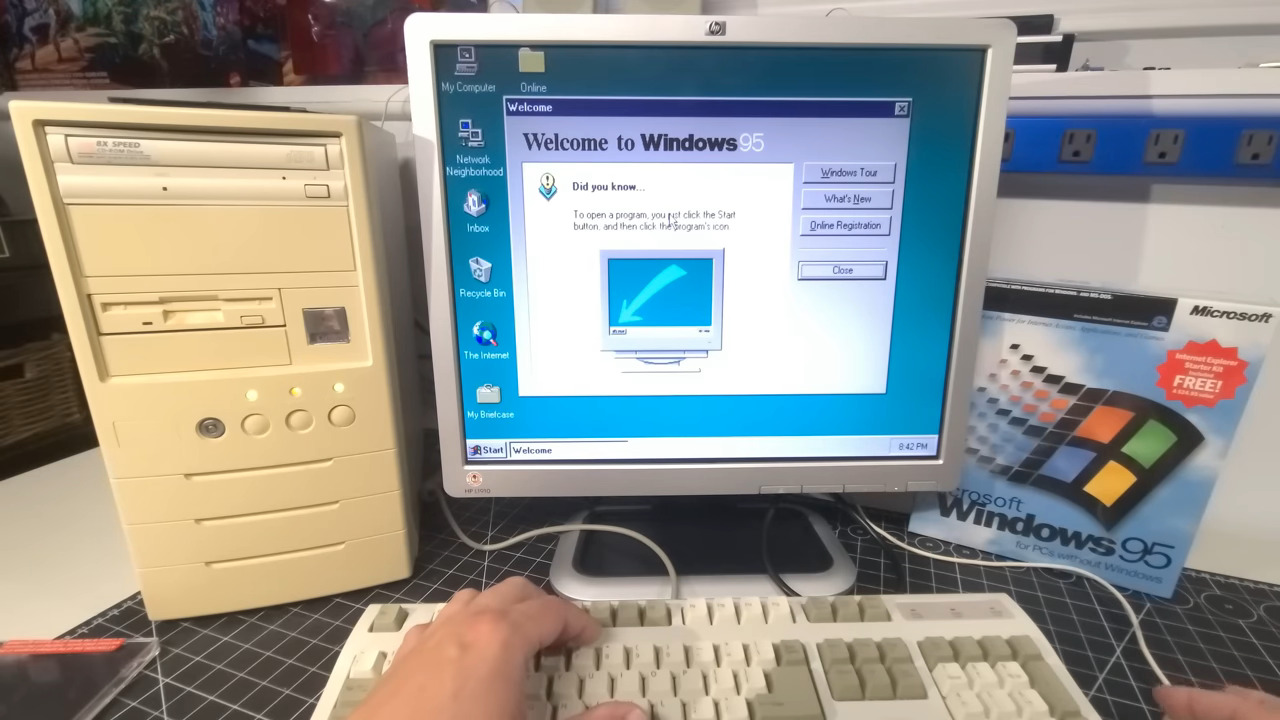
Then they had a scrolling animation with an arrow and some text ("Click the Start button to begin") that slid in from the right side of the taskbar and pointed right at the Start button.
I was around, though I wasn’t an adult where I was following the release at the time.
The first computer I used had Windows 3.1, but I never really knew how to use it. I just played some games on it and my dad would have me feed in a stack of floppy disks for him when he had to install something big.
Windows 95 was the first OS I used and explored on my own and made sense to me.
I agree that we had much better patterns back then. The software industry in general worked towards sharing visual paradigms, making use of system designs of their host playforms, facilitated discovery etc etc. All that was good and the recent trends moving us away from that consistency and discoverability are a detrement being steamrolled over by agents…
But I don’t agree that it “looked nice”. I hated Windows 95 and 2000’s “style”. They looked like engineers had made them. They looked stiff and unfriendly, eith too much border and outline. Real life has no outlines. I was in my late teens when 2000 came out. My friends and I jumped on it and felt it was the Os we had been waiting for.
But even then I thought it looked like shit.
The affordances were great. I agree that details like button depress and consistent scrollbars are valuable.
But I genuinely prefer things a bit rounder, a bit flatter, less grey, or late Aqua-style flat-with-shiny-affordances.
I agree that backgrounds should be flat (or very subtly textured so they recede but arn’t “boring; again, late-00s Mac OS nailed this for me).
What I’d really like to see is something new that takes the consistency of NT/2000 and Mac OSX prior to Lion, mixed with the novel affordances of BeOS/Haiku (docking windows, small title handles), and puts it through Apple’s “zing” (but not too far - transparency is highly overrated).
Computer UIs needed borders and outlines because there are no brain-intuitive visual cues: no depth parallax, no shading, nothing shifts as you move your head, and until relatively recently they had poor contrast and brightness variability compared to the real world.
It was also a compromise for interface device limitations. We didn't have 4000 DPI mice with scroll wheels and 26 configurable buttons; you were lucky to have a 1024x768 resolution; and 16 bit color was for people shelling out $$$. Obvious borders and some padding between elements were a necessity to click what you intended to click.
> Obvious borders and some padding between elements were a necessity to click what you intended to click.
That never changed.
> until relatively recently they had poor contrast and brightness variability compared to the real world
When has that changed?
And even if you mean the displays got better, the new Apple is fighting tooth and nail to erase any form of contrast from their UIs.
Of course real life has outlines. Look at these for instance:
https://www.reddit.com/media?url=https%3A%2F%2Fpreview.redd....

https://hackaday.com/wp-content/uploads/2026/05/skala_displa...

Displays & controls are thematically grouped and/or framed, each button/rotary/switch has a color that constrasts from the background, and there are strong 3D clues to see what's a button, and what's a label or the background.
You will never see a visually consistent operating system again, the material conditions that allowed for older Windows and Mac OS versions to be consistent no longer exist. The user base for desktop computers is no longer growing, so the investment into new desktop UI technologies is largely in technologies like Electron and SwiftUI that allow developers to cut costs by reusing their existing web and mobile interfaces for desktop software. The focus on cross-platform development means that developers are far more concerned about making their software look consistent across all platforms than they are about whether their software looks native on each platform it supports.
Andreas Kling has said that one of his inspirations for SerenityOS was the Windows 2000 UI (https://corecursive.com/serenity-os-with-andreas-kling/). I found his general goal for SerenityOS ("Roughly speaking, the goal is a marriage between the aesthetic of late-1990s productivity software and the power-user accessibility of late-2000s *nix.") to be strangely validating ('Wait... So it's not just me?!'). And so of course I decided to try out the KDE desktop, which I had always kinda dismissed as being a bit too much of a niche within a niche. And it's great. It really is wonderful to use an OS that is designed from the ground up for serious technical users. And the ubiquity of web apps nowadays makes Linux a far more practical choice than it was back in the day.
Windows 2000 was the peak of Windows UI. While features and functionality has improved in many ways, everything UI change since then has been a step backward.
Microsoft (and IBM and others) did a ton of good HCI research in the 70s and 80s, and used that research to make better UI for their operating systems. But sometime around the mid-90s when high-color displays started becoming the norm, UI experts started gradually being replaced by art-school types, and now it seems very little consideration is given to actual UI functionality, and the driver is entirely some bizarre sense of style from people who don't know anything about Human Computer Interaction, but seem to think no more deeply than "less is more".
These UI elements had reasons to look and act the way they did. This communicated information to the user (even if the user didn't realize it), and made software much more predictable and discoverable, and ultimately, more intuitive.
One of the things I miss being able to do in windows is arbitrarily drag around and arrange icons in a folder the same way you can on the desktop. Sorting files into piles of icons before selecting a pile and moving it into a folder was a nice way to get them originated. I think windows 7 might have killed that off.
> Hiding filename extensions was one of the capital sins in computer history
Amen. The first thing I do on any (Windows) OS installation is make sure file extensions are shown. I guess Microsoft did that for "simplicity", but it also made for easy "virus.jpg.vbs" files.
A puppy.jpg.vbs file would be shown as "puppy" with "VBScript" in the type column. The full name may be worse though. "puppy.gpj.vbs" (which is actually "puppy\u202Egpj.vbs\u202C") looks like an image extension, but is a script (as the type column also shows).
Edit: Looks like HN removes those directional override characters. When present, the text looks like "puppy.sbv.jpg"
Was this peak Windows UI?
I would say so, but the Active Dekstop stuff wasn't the right move.
Fisher-price came next, with Windows XP. At least you could easily switch back to classic.
And then Windows 8, we won't even talk about that.
Maybe more importantly, Win2k was the first windows version actually WORKED in a predictable way after years of unstable post-Win3.1 (Win95 and onward) production releases.
Yeah, but I would still usually see Explorer crash within an hour of a fresh Win2k installation. Windows 2000 was peak UI, but it wasn't peak Windows. That was Windows 7. And Windows 7 was advanced enough that you could still go back to the Windows 2000 UI.
Windows Vista / 7 was peak UI for me.
> I would say so, but the Active Dekstop stuff wasn't the right move.
Even so, you could completely ignore it if you wanted to!
The title bar of windows in Windows XP was Fisher-Price. But I thought the rest was OK.
I hated XP themes too
I felt the taskbar was the ugliest part of the themes
I think Windows XP looks very nice if you install the Royale theme. It's a shiny and glassy version of the default XP style.
I really liked the luna silver and olive green themes. They were not too bad to look at.
Almost. The NT5 RCs, which became windows 2000, were better IMO - not massive differences but it hadn’t been slobbered upon by marketing yet.
Design language, like any language is metaphorical.
The thing that makes these skeumorphic designs work so well is that it kinda forces a consistent metaphor, and consistency above all else is huge for UX.
The fact that it's based on things we've seen in real life is also helps, as it means we can reason about the UI with the same faculties we've spent our entire life training.
Why are designers not understanding this these days?
I think one reason is that flat UI is super easy. Skeuomorphic is extremely hard to get right, and if you don't get it right it looks super tacky. Most people who have the word "designer" in their job title don't have the artistic skills needed to pull it off. This is why most designers are opposed to skeuomorphic.
Somewhere in between is the right approach. The NeXTSTEP UI from the late 1980s is what we need to return to. It still looks beautiful today: https://guidebookgallery.org/screenshots/openstep42
> flat UI is super easy. Skeuomorphic is extremely hard to get right
What I don't understand is why those are treated as the only two choices?
Just adding some shadows, dividers, 3D buttons and real scroll bars again would go a long way to making things more usable without going full on into skeuomorphism to represent elements of the physical world.
A good example of the wrong direction was macOS in the switch to Tahoe. Buttons in modal dialog boxes became flat instead of 3D. They no longer look like buttons, they just look like a web-UI card with a gray background. There is no visual indicator at all that it is a clickable button.
Why? Legitimately, I want to hear from the designer(s) that made that decision and what their reasoning was.
I've been saying for many years that it seems most UI "designers" are just art school dropouts. Art school graduates would have a better sense of style, even if they weren't HCI experts.
Windows 2000 was peak Windows UI. Yeah, it wasn't visually exciting, but it was the peak of functional and discoverable UI. Of course, the Windows 10/11 UI isn't visually exciting either, and in many cases it's more boring looking, and definitely less functional. I would pay money to go back to the Windows 2000 UI, but I guess Microsoft isn't sophisticated enough to do that any more. The current Windows UI is less customizable than Windows 2. Yes, you heard me right. Windows 2.1 was more customizable than Windows 11.
Flat UI is also really difficult, as it can easily look cheap, boring, and unfinished.
Even Apple’s initial move to a flat UI in iOS 7 suffered from this. It took a long time to get refined to the point of not feeling like a major step backward. I still preferred the look of iOS 6 to anything that came afterwards. The skeuomorphic designs were warm, inviting, and fun. They served as a nice juxtaposition to the rather austere hardware.
What’s the meaning of skeuomorphic design for a generation that has never worked with the original physical artifacts they’re based on, though?
Consistency. Even if you've never held a telephone receiver, if it means 'call' in one place, it's very likely to mean the same thing in another.
We could be using random hieroglyphs to the same ends, but people seem to always make their own (barring a few exceptions, like the hamburger menu). It's probably a better idea to use something with some grounding in reality rather than make your own from nothing, since doing that is hard, even for actual designers.
It also takes a long time for those purely digital ideas to filter out into the mainstream and get a shared name. For many years I would hear people same, “click the thing in the upper left corner”, “click those 3 lines up there”, or something similar. The term hamburger menu is starting to filter out there to the point where I feel comfortable using it. Even the term, hamburger menu, is a skeuomorphic name for a digital control. No one knows what to call those 3 lines, but everyone knows what a hamburger is. I’ve even seen some sites use a literal hamburger icon.
It also took a long time to standardize on the hamburger menu. Many also tried to use an ellipsis for a long time. Some still do. Sometimes those dots are vertical… is that a thin hamburger or a vertical ellipsis? I heard one person trying to make the term “tots” happen for this style of menu… tatter tots to go with the hamburger.
Contrast that to a “gear” menu for settings. They see a cog or a gear and everyone knows what that is without training, even if they aren’t a mechanic.
They create a consistent design language.
Do you need to know the meaning of the latin words manus (hand) and facere (to make) to understand the English words manual (by hand), factory (place which makes things) and manufacture (to assemble)? Do we need new words now that Latin comprehension is dwindling? Not really.
Language works by metaphor, even if the thing you're alluding to doesn't exist anymore.
It doesn't really matter if they haven't used the original physical artifacts. If it looks physical you can figure out how to use it based on your knowledge of other physical objects you have used in your life.
Of course if you display for example, a spin dial like old telephones that has a particularly quirky way to use, them this doesn't apply.
That does look surprisingly good. And dated. For some reason my first thought was "why the hell is this reminding me of Carmen San Diego?!"
Following the standard is easy, deviating from it is hard.
Every designer nowadays insists on deviating.
You still need some design experience and "taste" though.
I've seen some B2B apps which used the Windows look-and-feel and looked absolutely awful: Actions wildly scattered through buttons, menus and context menus, panels and tabs nested several layers deep until the UI started to look like a canyon formation - and no icons or color at all, because I suppose those would have been "unprofessional" - so everything was in dull gray.
(I think it's worth realizing how colorful the stock Windows dialogs and applications actually are through the use of icons, even despite all widgets being gray.)
I still believe the Windows 2000-era UI toolkit is one of the best, because at least it gives you straightforward pathways to build a good-looking and usable UI - but you still have to want to do it.
Like the floppy disk for “save”? Or the old school phone receiver for “call”?
For icons and some aspects of functionality why not as a starting place?
Where it falls down is when designers force too many of the paradigms of the RL original onto a platform that doesn't suit it [0].
[0] See for example the Mac OS X Address Book app https://www.betalogue.com/2012/01/15/abook6-dumb/.
There's nothing wrong with either of those.
No different than "windows" or "desktops" or "files." When was the last time you actually saw a file folder? Or a document separated by sheets with "tabs."
95% of computer users have never seen an ethernet cable, but they're still the symbol for networking.
99% of car drivers have never seen brake calipers, but they're part of the icon when my car's parking brake is on.
> When was the last time you actually saw a file folder? Or a document separated by sheets with "tabs."
Every day because normal functioning adults still need to keep paper records of things.
> While we're at it: Hiding filename extensions was one of the capital sins in computer history, if you ask me
So true! Does anyone know why this happened?
It's been the default since Windows 95, and I suspect it's because it was just noise to the average and upcoming computer user (ignoring the fact that coolsong.mp3.exe would soon become a problem, since that probably hadn't happened yet). MacOS functionally did the same, so MS probably wanted to seem equally 'sleek'.
The fact that it continued to be the default past Windows 98/ME/2000, when problems caused by it were widespread, baffles me though.
I can't find a source to find an exact reason though, and given it's been a thing since 95, there might not been one out there.
I really liked when XP came out, and you could have both the clean 2000 look with advanced font rendering like cleartype. That was the perfect combo for desktop use.
I had my xp running a blackbox 4win and coLinux/cygwin, then moved onto vmware/virtualbox with windows vm and linux desktop, now I'm doing win11+wsl2 and loving it for cuda/ai/building projects.
> In Windows 95, those toolbar icons were still actual buttons. In Windows 2000, they are recognizable as a button when activated, but in their default state they're not and you have to hover over them:
This is something I've struggled with as toolkits change and old widget themes stop working. There are still some decent themes out there (e.g. Skulpture for Qt has been my default for many years), and with a little patching they can be dragged into working on the latest toolkit versions. Yet I can't seem to avoid this "you have to hover over to see that it's actually a button" behaviour. Very annoying!
RE: Start Menu, the article does not mention or show the obnoxious “Personalized Menus” feature which is the one and only ‘must disable’ when I use Win2k. It triggers after some number of days and hides infrequently-used programs from the Programs submenu as a workaround for the menu growing large and unwieldy when many programs are installed, but IMO I think it's even worse than what it claims to fix.
In the 90s and early 2000s, Microsoft had a lot of good UI, but their defaults were always really poorly chosen.
The loss of the theme menu and 'Windows classic' from Windows 8 onwards is dearly missed. But Windows classic hasn't gone away. If you run a 32-bit executable on Windows 10 or 11 under Windows XP compatibility mode, and set 'reduced colour mode', Windows Classic comes back. I have also noticed that when Adobe Acrobat crashes (heh) it momentarily flashes Windows classic on the title bars.
It's all still there. Bring it back, Microsoft. And put HiDPI and all your other modern technologies like D3D12 and borderless full-screen on it. I want to write old-school Win32 applications that fly.
For me Windows 2000 Professional is the best OS that Microsoft ever released. At the time I used it was really polished, stable and fast.
One recurring question that I keep asking myself is why UIs have to constantly change for the worse?
What would happen if vendors kept using the same UI for decades? Would people hate or love having a one well thought UI?
> One recurring question that I keep asking myself is why UIs have to constantly change for the worse?
So the designers have something to do and so the CEOs have something easy to think of when they need to 'shake things up'.
That's all I can think of. I can't think of any that actually benefit the user (barring your original UI being absolute garbage, to the point anything else is an improvement, but even then, the original UI should still be available in some capacity).
> What would happen if vendors kept using the same UI for decades? Would people hate or love having a one well thought UI?
They hate having to re-learn UIs every 5-10 years (per OS/application/website!), so I don't think you've got much to lose trying to maintain a single good UI. And in the few cases where the UI basically hasn't changed in a long time (XFCE, VLC, probably more), they fucking love it.
For me: everything! I clicked so well with it, everything made sense and was responsive.
It was clear, clean and understandable.
Buttons looked like buttons.
Windows (which have frames), looked like windows.
And there was no distracting design elements.
I remember those times and there were a lot if windows that did not look like windows and buttons that did not look like buttons. Not in the apps provided by the OS itself, but in third-party software. It was the time of wild experiments, especially in software created by enthusiasts. We just tend to forget this stuff
It's not like the world was perfect before; it's just that it's gotten even worse. The lack of consistency has spread, to the point there barely is any.
Application developers often had a lot of crazy (and bad) ideas, but at least Windows itself was consistent. But then those crazy, bad ideas started affecting Microsoft, and then you could make the Windows Media Player look like eyeballs.
"Skinning" apps was a good idea in theory, but in practice, it never offered anything better than the default of Windows 2000 and earlier eras. Now you can't change anything in the Windows UI except a few colors.
And crazy themes I had the matrix one with the "dodge this" sound instead of a ping... good times
This is why I run XFCE with the Chicago95 theme. Sure, it's Windows 95 but the 2000 UI wasn't a big divergence from memory. It's familiar and gets out of the way. https://github.com/grassmunk/Chicago95
The article praises the UI, but isn't Windows 2000 using the Windows 95/98 UI with a different kernel?
Hold on, don't give cred it to Windows 95. The beveled 3D look was the invention of NeXT. Windows 95 copied everything from them. https://guidebookgallery.org/screenshots/openstep42
Amiga workbench was similar, although cruder, starting in 1985. I think it was just happening all around at that time.
The different kernel for 95/98 was NT 4... Windows 2000 was unified, same UI for Consumer and Server
There is no version of Windows 2000 for consumers.
Windows Me was the nearest consumer release (2000 came out in 1999, Me in 2000), and did share most of the same UI, but was based on Windows 98.
Windows XP was the first version of Windows to ship with the same codebase for both consumer and business.
Windows 2000 Professional was the non server edition no? That's the one I was running AFAIK.
https://en.wikipedia.org/wiki/Windows_2000#Editions
But you might be right by meaning consumer is non business user.. I also ran ME for about 2 weeks lol
> I liked the UIs of the entire era from 3.0 to 2000, really. I'm mostly using Windows 2000 as an example here because it runs so well in QEMU/KVM and that allows me to easily take screenshots.
I agree with the author's wish for visual cues when something is clickable, scrollable, etc.... This, on the other hand:
> Imitating real objects is good, too -- I don't have a single one of Android's "sliders" anywhere in my house, for example, so why don't you make this a checkbox, because writing down a check mark on paper is something that I actually do:
feels like an idea from a time when many people were encountering UIs on screens for the very first time as adults. I think the slider would be recognized as a toggle in its usual context of a settings screen by most people who have seen a settings screen before, but not that specific design for a toggle.
> I think the slider would be recognized as a toggle in its usual context of a settings screen by most people who have seen a settings screen before, but not that specific design for a toggle.
I've been using computers since the early 90s; we got our first home computer when I was four; I've used many different operating systems.
As a professional Web developer, it took me an embarrassingly long time to figure out what those slider widgets are supposed to mean. It's still very easy to get them wrong/confused (both as a user, and as the designer/dev making the form), e.g. when the affirmative state involves a negative setting, like "Mute" (does "on" mean "muted"; or does "on" refer to the audio, which I can use this to mute?)
There is a specific UI guideline for something that can be enabled or not: it's called a tick box. The on-off switch thing is a distinctly iOS invention [1]. The funny thing is that OS X (now macOS) mostly held off using those 'switches' too, until fairly recently.
The switch widget is for settings where flipping the switch takes immediate effect, unlike a checkbox where you have to press some "OK", "Submit" or "Apply" button. In Windows 2000/Office UIs, this would've been shown as a button that could visibly switch between "pressed" and "not pressed" states, just like a push-down switch, but that was rarely used. The modern labeled switch design is a lot more intuitive than that.
> The modern labeled switch design is a lot more intuitive than that.
In a lot of the modern switches I meet with the colour choice makes it totally unclear which is on and which is off.
Ok, if it's a cookie acceptance dialog it makes sense to do dark patterns, but I've seen it in legit apps too.
Whose specific UI guideline are you talking about? Android's recommends the switch component for setting toggles: https://m3.material.io/components/switch/overview
I liked every version of Windows that I’ve used, back to 3.1 all the way up to 11. Nowadays I mostly use 10/11 at home and at work. A new Windows upgrade was always a magical treat for me, the old slow HDD speeds building up anticipation during the installation phase, making me excited to finally use it. Growing up with computers unfortunately demystifies many things, but such is the price of poignance.
Maybe relevant: http://windows93.net/
Yeah, Win 2000 is still my favorite Windows version, UX wise.
Clean, concise, no surprises, dependable.
I still use this background Color on my Mac or Linux.
When are we going to start designing UIs based on scientific HCI instead of marketing BS? Or has that gone the way of the dodo?
When was the last time someone published a proper article that involved HCI that got even the slightest bit of attention? It's been dead for a long time as far as I can tell (last time it was alive was probably back when Win2K was relevant!).
I agree with these points, but I will still be disagreeable and take a more nuanced position: Windows NT 5.0 Interim Developer Release build 1796 (and some preceding builds) were peak Windows UI, because they had all the points in the article, plus a "show desktop" button in the lower right corner that you could blindly throw your mouse at-- a feature relegated to a Quick Launch action from the subsequent build, and only restored in Windows 7.
Check it out: https://dn721308.ca.archive.org/0/items/usa_1796.1_winNT50.w...

When Windows XP came out, computer magazines wrote articles on how to switch the more modern, colorful UI back to the old, grey, drab, boring UI of Windows 95/98/2000.
I was young at the time and this seemed absurd to me. Why would you willingly use a UI that looks like wearing an old grey tie for a dusty office job in a depressing concrete building?
The older UI was also noticably faster. The new UI looked like a daycare: saturated colors and all thick, rounded borders on everything.
I was youngish at the time and thought Windows XP looked like clown vomit.
There is a German saying "Grün und blau schmückt die Sau" ~"green and blue grace the pig" - and XP was green and blue and shiny like hard candy.
Windows XP was the first OS I ever used and still I switched to the classic UI because it looked just better in my opinion.
Some people like brutalist architecture.
I think is so ugly that I'm half tempted to chatgpt fact check this comment. It very well could have been a deliberate conspiracy to lie to the public and say it looks good to make some austerity go down easier.
I hate brutalist architecture, but love the Win2K design language, for what should be fairly obvious reasons. I interact with software. I don't interact with architecture beyond the visuals. It can look as shit as it wants, but if it gets out of my way and lets me do what I want to do, then it's great. It'd be nice if it look better, but I'll take function over form 10/10 times.
The only reason brutalist buildings were made in that style is because it's cheap(er), and because some architects started to smell their own farts a bit too much. Win9X/Win2K were made the way they are because it's actually conducive to get shit done.
win2k is the goat. fast, clear, no bullshit. sadly rdp and cleartype dragged me away and i've regretted it ever since.
On Windows 7 it was still possible to have the Win 2000-esque UI. I think it was an option between the classic UI or the fancy UI with gradient buttons and translucency and slowness.