
Moving in the right direction, but unfortunately it's still quite a few years before H264 is off patent, globally:
https://meta.wikimedia.org/wiki/Have_the_patents_for_H.264_M...
At which point, the continued march towards higher resolution and bandwidth video will probably limit their utility
> At which point, the continued march towards higher resolution and bandwidth video will probably limit their utility
Just as the patent system intended: maximum extraction was enabled while the product was useful.
Now if only copyright didn't last forever..
Why? The Beatles really wrote and performed Strawberry Fields.
Why are you entitled to it for gratis? It’s a taking for public benefit.
Ancient writings like Plato or Marcus Aurelius somehow feel different. But high-fidelity live recording feels like it shouldn’t go into the public domain. It’s someone’s commercial work product
The Berne Convention has permanently burned us there
Past international agreements are only as permanent as the people alive now agree they are. Yes this one will be very hard to change but that's just because there are many powerful interests that want to keep it this way.
[the United States Congress shall have power] To promote the Progress of Science and useful Arts, by securing for limited Times to Authors and Inventors the exclusive Right to their respective Writings and Discoveries.
https://en.wikipedia.org/wiki/Copyright_Clause
The purpose of the system as it was originally conceived was not to provide maximum economic extraction -- the purpose was to promote the progress of science and useful arts.
It is not necessarily the case that the maximization of economic extraction coincides with the progress of science and useful arts.
I am familiar with the Copyright Clause. You need to remind the courts, Congress, and rights holders, not me. If I had my way, rent seeking would be dead.
Interesting how you’ve chosen to interpret that section.
When I was in law school we were taught what seemed obvious then and is obvious now: that Congress has the power to promote the progress of science and useful arts by giving authors and inventors exclusive right to the economic fruits of their works. You can argue about flaws in the system but it’s pretty laughable to suggest that copyrights and patents don’t exist for the purposes of maximum economic value extraction for inventors and authors.
There is quite literally no other reason for granting a copyright or patent. It’s also why if a plaintiff is successful in a claim for an infringement of either, he’ll get awarded money in the United States that at a bare minimum is designed to compensate him for the money he would have made if the patent or copyright had been complied with. Europe has some different ideas about moral rights in this space, but since you’re quoting US material I assume you aren’t referring to our funny brothers across the pond.
It’s obvious to most people that humans act in certain ways due to incentives, and we like to incentivise invention and creativity in the West.
Copyrights and patents don’t exist for the purposes of maximum economic value extraction for inventors and authors.
They exist to maximize the production of scientific and artistic works and do so by incentivizing creators with a limited exclusionary property right over the created work.
If the goal of this particular section were to maximize what authors and inventors can extract from their creations then explicitly assigning to them the property rights in perpetuity of said creations would have been the way to ensure that outcome.
Given that they specifically wrote "by securing for limited Times" it is entirely reasonable to make this interpretation and I'm not sure why you weren't taught this interpretation in law school -- it's a pretty settled thing and there have been many times that this subject has come up in US courts over the years.
And this isn't so whack if you stop and think about it. There are all kinds of limitations on intellectual property rights.
Like take trade secret protection for exampple -- it has no term limit and no disclosure requirement. If maximum extraction were the goal then patents would look like trade secrets. Instead the bargain that the patent system forces on creators requires them to publish their invention and then hands the rights to that invention to the public after a finite period of time. The system is explicitly designed to be less extractive compared to others on purpose.
And if copyright is built for maximum extraction why does it carve out an affirmative defense in the form of fair use for others to use copyrighted works without paying? Same with first sale, same with the idea/expression dichotomy -- so much of the antisocial contemporary intellectual property regime is configured around providing people free access to the use of intellectual property.
> There is quite literally no other reason for granting a copyright or patent.
"To promote the Progress of Science and useful Arts, by securing for limited Times to Authors and Inventors the exclusive Right to their respective Writings and Discoveries."
It seems pretty clear to me from that sentence that the stated purpose of these laws was to drive the creation of science and art and that a limited time profit incentive being enshrined in law was merely a carrot to create an incentive for that.
The framers understood the complex interplay between property rights, freedoms, and incentives in driving innovation and creation.
Knowing that granting someone an exclusive right to something that isn't subject to finite physical limitations effectively denies everyone else in society that same right the framers still understood that it was necessary to abridge the freedoms of some to enrich society as a whole through the development of science and art.
In choosing to use the words "for limited times" the framers encoded the economic priority of the majority of society over the economic priority of the minority of creators into this section but they also did not give a specific time which to me speaks to their understanding of the complexity the interplay between all the factors and allowed for the possibility that they could change over time.
On damages: that's a non-sequitur. How a system enforces an entitlement once created tells you nothing about why it was created. Tort damages compensate plaintiffs but nobody woudl say that tort law exists to maximize plaintiff recovery.
It isn't in dispute that people respond to incentives. That's precisely why the size of the incentives and the configuration of the incentive structure matters and why we have things like term limits and fair use.
I'll come back to this - it's been awhile since I studied it and a cursory examination of my old notes has me spotting some misconceptions on my part as expressed here; at the very least I could have expressed myself better in both posts.
> the goal of this particular section were to maximize what authors and inventors can extract from their creations then explicitly assigning to them the property rights in perpetuity of said creations would have been the way to ensure that outcome.
Actually it’s the opposite - both patents and copyrights expire after a period of time, which is the compromise we’ve reached between incentivising people to make money for themselves personally (giving them a legally protected right over their creations), and allowing wider society to benefit from inventions and scientific discovery. The fact that patents and copyrights do not exist in perpetuity points towards the idea that they exist to promote invention and scientific discovery in ways that can be commercially exploited but only for a limited time, usually by their creator or inventor (or his heirs under certain circumstances).
Not sure what else to tell you. This really isn’t that complicated or controversial, in the US at least.
Intellectual property is total bullshit as a concept but I suppose patents are at least tolerable since they only last 10 to 20 years, unlike copyright which lasts for our lifetimes plus a million billion years.
I really have a hard time accepting software patents. Like amazon patenting the one click to buy shopping cart for example. Crazy Taxi patented a directional arrow... The infamous "nemesis" patent for shadow of mordor.
IDK.... its all bits and bytes. This seems to stifle innovation more than anything imo.
Me too. Intellectual property in general is so incredibly absurd it's actually disgusting, but in the case of patents at least they actually end within a person's lifetime. That's the only way I can cope. Unlike copyright, you and I are going to reap the benefits of those patents one day.
Also, it's just not true that products will be useless by the time their patents expire. Example: semaglutide patents have already expired in my country. Competitors immediately entered the market and it led to prices free falling to about a third of what they used to be. These past few months I had drug reps visit every week with lower and lower prices to the point it became hilarious to watch them try to outmatch each other. So many people are going to benefit from this. Looking forward to the day tirzepatide gets its turn.
What annoys me the most is that they are so damn obvious! I can understand patenting the steam machine, but most software patents are simply the first solution which would come to mind to any developer encountering the same problem.
What's next, I can charge people money for using the number 65234563124 because I'm the first to file a patent for it?
> I can charge people money for using the number 65234563124 because I'm the first to file a patent for it?
Absolutely.
Creative works are files in a computer, data. All data is information. All information is sequences of bits. All sequences of bits are numbers.
I can even calculate how big those numbers are given their bit count.
  digits(bits) = ceil(bits * log10(2))

  digits(32)     = 10
  digits(64)     = 20
  digits(128)    = 39
  digits(256)    = 78
  digits(512)    = 155
  digits(1024)   = 309

  digits(20 KiB) = 49,321
  digits(2 GiB)  = 5,171,655,946
That's how absurd this system is.
Fortunately, the laws are (currently) implemented by humans, not robots. Patents aren't copyrights aren't trademarks. Copyright isn't a perfect system, but it's the system we have to promote the creation of creative works. It's been perverted by corporate interests, but it has seemed to serve us well enough over the past 250 years. Simplifying it to owning a number is an oversimplification that loses too much resolution because the numbers aren't short ones, they're because computers work on numbers, so the story of Harry Potter and the Sorcerer's Stone on a computer boils down to a number to a computer. But it's more than just a number. It's a book with meaning and words, and so logic wants us to reduce it to call it ownership of numbers, but humanly speaking, if JK Rowling wrote a book and it was popular, it doesn't seem absurd for her to get rich off of it.
Patents, unless it's for something truly exceptional, just seem like a good system for getting lawyers rich.
Trademarks I believe in though. If I buy a Caterpillar bulldozer, I should be able to believe that I'm getting a genuine Caterpillar bulldozer, and no one else is allowed to use the name.
Our systems of intellectual properties have been abused, so it's fun to think about culture shifting to one of intellectual property nihilism, but I don't see that happening in my lifetime.
I have the opposite opinion. Patents are tolerable, while copyright is so intolerable that copyright infringement becomes civil disobedience and arguably a moral imperative.
Tolerability is a function of how long the monopoly lasts. The social contract was we'd all pretend we couldn't trivially copy works for some years so that creators could make their well deserved profit, and then the works would enter the public domain. When's the last time you saw your culture enter the public domain? JK Rowling has made her fortunes several times over, yet you and I will be dead for around a century before those works become public.
Nearly two hundred years ago, one man warned everyone this would happen.
https://www.thepublicdomain.org/2014/07/24/macaulay-on-copyr...
> At present the holder of copyright has the public feeling on his side.
> Those who invade copyright are regarded as knaves who take the bread out of the mouths of deserving men.
> Pass this law: and that feeling is at an end.
> Men very different from the present race of piratical booksellers will soon infringe this intolerable monopoly.
> Great masses of capital will be constantly employed in the violation of the law.
> Every art will be employed to evade legal pursuit; and the whole nation will be in the plot
> once it ceases to be considered as wrong and discreditable to invade literary property, no person can say where the invasion will stop. The public seldom makes nice distinctions.
> The wholesome copyright which now exists will share in the disgrace and danger of the new copyright which you are about to create.
> in attempting to impose unreasonable restraints on the reprinting of the works of the dead, you have, to a great extent, annulled those restraints which now prevent men from pillaging and defrauding the living.
Did people listen? No. They doubled down on functionally infinite copyrights. If lasts even longer now. These are merely the results.
I don't think video resolution will increase all that much in the future, except for niche uses, as the resolution of the human eye becomes a limiting factor.
Pretty much. 1080p it very good, 4K is near perfect to me. By the time you can see the pixels you are WAY too close to the screen.
4K is already at the point where a lot of the additional detail you're getting is noise. 8K is just a joke for people with too much money.
You may be underestimating the desire to earn through differentiation.
Assuming the product companies accept the plateau on resolution (I agree it’s likely), there are many ways to exploit the other stuff. Colour space, tacling each type of compression artifact, additional channels (probly not long until we have HDR RGBW), etc etc and those will each come with their committees made of patent-hungry companies seeing non-encumbered encodings as “undesirable”
You can only ask so much more before customers stop buying your "better" product without seeing some real value. 4K HDR is already at that point (for home video releases anyway).
I don’t think it matters in a practical sense. Our streaming overlords have already shown that by crippling the effective color space of supposedly 4K video they care little for quality of broadcast. Crushed blacks and smeared video are all you’ll get no matter what the standards say. They were, are and remain terrible on 1080 video, 4K is a farce.
You’ve missed the point: each addition can (and likely will, based on history) be the way to bring more patents into the market. It rarely has anything to do with objective quality (except in the marketing)
I read "resolution" as pixel count more than DPI.
As it becomes cheaper to capture and process higher res content, we're bound to push it to bigger displays (VR included). I guess the human eye will be the limit when we're at retina levels of DPI on a sphere.
Most videos are probably going to stay aimed near 30-40 degrees of width. So while we already can do 8k or higher pretty easily, 4k is enough for a huge amount of content. Even 1080p can hit "retina" at 30 degrees, if barely. And while that threshold for "retina" is flawed it's pretty good for video content.
We'll see how much 360 content shows up, but the size gap is so big it basically needs to be handled entirely differently. A 16x9 screen, 40 degrees wide, is only 2% of a sphere.
For distribution perhaps, but for acquisition it makes sense to have the highest resolution possible.
Read the list of patents left: a lot of them are on SVC (no one uses this) and on higher profile.
For a lot of use cases, including Basic and Main profile, H.264 is already free.
Main profile is very mediocre. Any file I see in the wild is encoded in high profile.
At least there are diminishing returns so H.264 will stay "good enough" for much longer.
Hey now, MP3 is still relevant even though better codecs have come (and gone)
Something tells me H264 is going to be sticking around for a while just on sheer compatibility and compute requirements
Very likely, look at JPEG. It was released in 1992 and it is still wildly popular on line.
> While the US and EU patents around MPEG-4 Part 2 expired in recent years, until today there remained one patent still active in Brazil.
Since MPEG-this Part that is hard to keep straight, this is the MPEG standard backing Xvid and DivX codecs. So let's encode video and torrent like it's 2002!
Time do get out the old CD of The.Matrix.1999-DVDrip(aXXo).Xvid.
I specifically remember that my dad brought from work crappy projector and I watched Harry Potter and the Order of Phoenix that was RMVB encoded camera rip from cinema. RMVB was all the rage on my 128kbps internet.
FWIW, Via Licensing listed this patent as standards-essential to several MPEG codecs (AVC/H.264, HEVC/H.265, VVC/H.266), and it's also listed for VC-1 (a SMPTE standard).
The openness of those codecs depend on the last patent expiring, not the first.
Of course.
> So let's encode video and torrent like it's 2002!
Let's have a meet up a Circuit City!!
I’m not sure how to get there. Do you have Microsoft Streets and Trips directions I can print off?
Note that MPEG-4 part 2 is H.263/DivX/XviD, not H.264.
Yeah. I think h264 is coming soon, too, though. Most of the remaining known h264 patents expire next year, with only one patent extending out further.
I do believe that more modern codecs like h265 and AV1 have a lot to offer us, but having h264 be fully unencumbered by patents will be nice. By modern standards it is very well-supported in both hardware and software, computationally cheap to encode and decode, and still does a good enough job for most use cases. h264 doesn't seem like it will be displaced any time soon to the degree that h264 once displaced its own predecessors, though obviously that's not to say that we don't see or won't see more adoption of newer video codecs across the internet in general, just that I think the h264 long tail will be one of the longest long tails of a video codec.
And thanks to the availability of codecs like AV1 which are effectively not patent encumbered (seems there is no practical reason to take the threats otherwise seriously) it seems the era of patent encumbered media formats is slowly coming to a close. Good riddance.
edit: Bit of a mess but here is some source for the h264 expiration.
https://meta.wikimedia.org/wiki/Have_the_patents_for_H.264_M...
So it seems 2030-11-10 is the date where h264 (version 3) will become patent unencumbered world wide, a bit earlier for the U.S. The other profiles/newer versions like AVC/SVC will take a while longer.
> computationally cheap to encode and decode
Well I'm not sure about decode, but as of a few years ago weren't h.265 and AV1 able to do much better compression than h.264 at almost all levels of compute? https://people.videolan.org/~unlord/SVT-AV1_BD-rate.png And h.266 encoders can probably go faster now too.
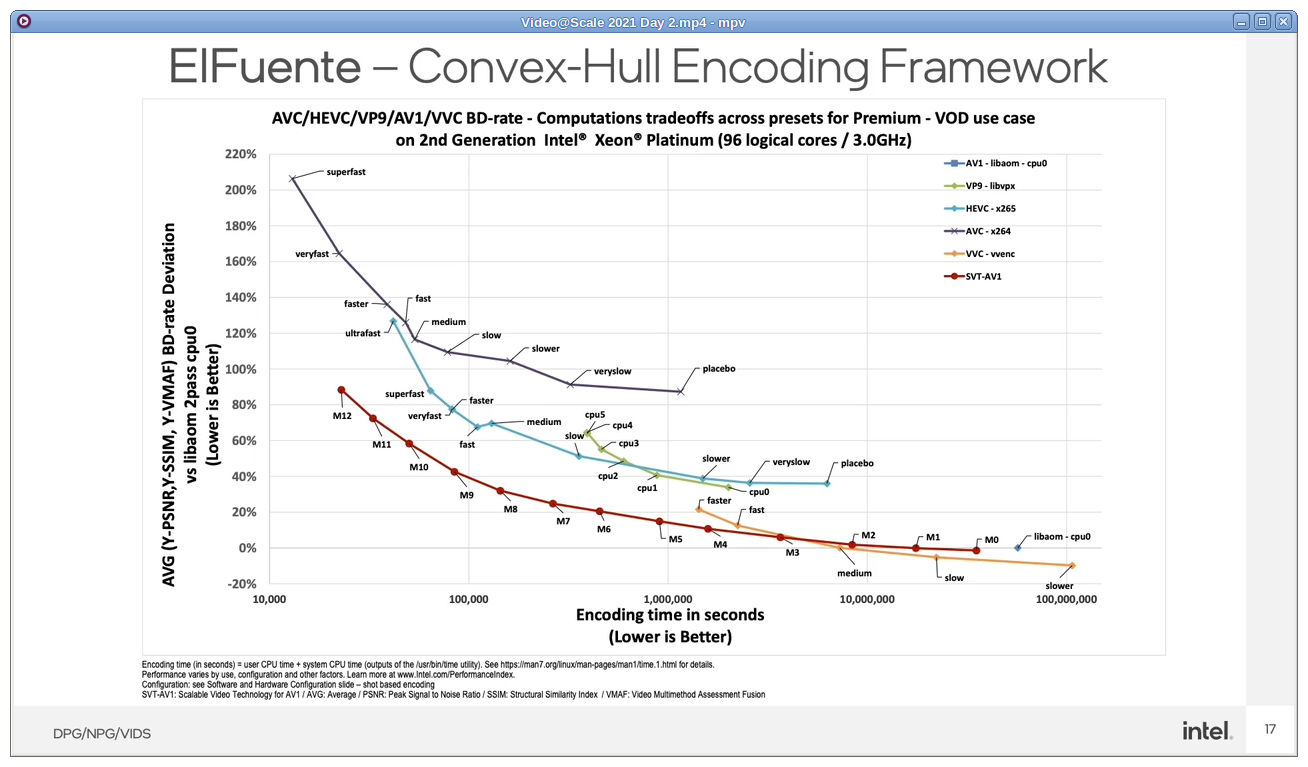
I would hope so! Otherwise the Pareto front wouldn't have moved in ~20 years which would be rather hard to believe.
However, at the same time, h265, h266 and AV1 are all vastly more complicated, and will have less broad hardware acceleration support than h264, which, again, even if it is not optimally efficient use of compute, just doesn't require a whole lot by modern standards.
So I'd argue there is really no reason to be rushing away from h264 unless you have a compelling reason. There are some obvious compelling reasons in some cases; nobody is going to be terribly surprised that an entity like Netflix is eager to switch to codecs that will save bandwidth, because at their scale saving bytes definitely adds up, bonus points if it can increase the quality at the same time.
On the other hand, though, unless you are absolutely sure you can switch to only new codecs, you will probably want to keep some h264 encodings around to act as a fallback baseline for legacy devices. And thus, you also have to take into account the complexity brought on by needing to store and maintain multiple encodings - in many use cases, like simple <video>s thrown into website backgrounds, I can see just eating the extra bandwidth costs and keeping it all h264 as a valid strategy.
Once the patents expire, I expect to see H.264 become the JPEG of video codecs - it may not be the most efficient format available, but it's widely supported, relatively easy to encode/decode, and good enough quality for many use cases.
(MP3 is in a similar place. AAC and Opus are technically superior, but everything supports MP3.)
>(MP3 is in a similar place. AAC and Opus are technically superior, but everything supports MP3.)
Actually MP3 is more like the H.263 / Divx here. AAC-LC is more like H.264. The difference in support of AAC-LC and MP3 is near zero, both in terms of hardware and software. While AAC-LC is vastly more superior. AAC-LC has been declared patent free ( all patent expired ) by Redhat for 9 years already.
The only part that is not perfect is there isn't a decent open source AAC-LC encoder. While you could use QAAC using Apple's encoder in iTunes. It would still have been better if there was an open source version. Luckily we just have a new AAC encoder with FFmpeg, it is doing great for and although sill not Apple's quality. But hopefully improve in the future.
Or Apple could have just open source the god damn thing.
I was under the impression that the new FFmpeg nmr codec indeed outperforms the Apple one in every bitrate with Google's new Zimtohrli benchmark as well as ViSQOL. That would suggest Apple doesn't really have to open source anything, we should be good?
Still, I don't see the point. Unlike video, audio decoding is so cheap you can practically do it on software even on fairly constrained devices. So really only in places like Bluetooth headphones where codec complexity can have a direct impact on battery life does it actually factor in. I say for most purposes people should just be going Opus today: it is far ahead of basically anything else. In most cases, for old devices you can simply ship software codecs instead.
Hell, Wikipedia ships video software codecs in the form of ogv.js, mainly because a lot of Apple devices wouldn't expose VP8/VP9 support even on SoCs that had hardware support for it, and that works surprisingly well. So for something like Opus, obviously it is trivial even on older hardware, even in the confines of a web browser. (And of course, Wikipedia uses it for Opus as well, but my understanding is this is only necessary for 1-2% of Internet traffic since most devices/browsers support Opus these days)
That may leave some niches where AAC-LC is still a reasonable choice, like maybe old PMPs. However, I reckon that there are probably a lot of older PMPs that in fact, don't natively support AAC. For example, the trusty Sansa Clip+ from 2009 doesn't have AAC support. If you were to install third-party software such as Rockbox, well, then you'd have Opus support.
So for audio, I think barring any specific reason not to, the meta is to basically always choose Opus.
>I was under the impression.....
Yes. But subjective testing by IgorC ( of HydrogenAudio ) shows it wasn't as good as Apple. It was a lot better than previous FFMPEG though. I believe we will have a few more listening test results coming out soon.
>That may leave some niches...
iPod has over 80%+ of portable music players market share. And almost all the others shipped at the time, from Creative to other Chinese brands, car audio, TV and media player has AAC support. AAC-LC hit a sweet spot of near same MP3 hardware support while being so much better. 320Kbps MP3 still don't compete with 256Kbps AAC-LC on Apple Encoder. On the other hand, there are only a few samples where 256Kbps AAC-LC isn't transparent, barely noticeable difference but no artefacts compared to Opus in professional listening test, 95% of people wouldn't even notice. Opus do shines at 128Kbps to 160Kbps range where AAC-LC don't compete ( or dare I say wasn't even tuned ), but loses nearly all hardware compatibility.
If we were streaming, and storing music or audio tracks with 128Kbps then Opus would have had strong advantage. But we live in a world where we could even stream uncompressed audio files with plenty of bandwidth left. The file size of audio is so small it makes it negligible in consumer settings unless you are Youtube. ( I would still prefer a 256Kbps audio codec, for me it was instantly noticeable. I think Youtube at one point switched for premium but decided to switch it back )
For web then I guess there is an argument for Opus. But I keep saying the same with Video Codec as well. There is a whole world of Video and Audio Codec usage outside the web and PC / Smartphone. We could have used AAC and called it a day. And it is not just patent unencumbered, it is patent free.
If I was for a new Audio Codec, I just wish it could achieve what AAC-LC 256Kbps did with 128kbps. i.e I take quality first over potential bitrate savings. But the half bitrate marketing hasn't been true since MP3 Pro, HE-AAC, HEVC and VVC for "low bitrate". Neither HEVC or VVC could achieve what AVC did with 2Mbps in 1Mbps. VVC being very close, I would guess FVC / H.267 will finally be it, but at what complexity cost? We have hit sort of limit of compression. Both in Video and Audio. And today we have very different set of trade offs between file size, connection bandwidth, compatibility and encoding / decoding complexity then what we did 10-20 years ago. And I would choose compatibility + slightly larger file size for its simplicity.
Well a lot of the improvements cost more computation. I wouldn't be surprised if low-computation video had only improved slightly, but it seems like it has improved a lot. The advantage of h264 is hardware adoption much more than actually being computationally cheap, it seems? Well, maybe. The thing is, I don't know how the decoders scale. Can you make a decoder for a constrained AV1/h.265 in the same hardware space or maximum CPU budget as an h.264 decoder and still see very big advantages?
just that I think the h264 long tail will be one of the longest long tails of a video codec.
I think MPEG-1 and 2 (from which MP3 comes) might be even longer.
MPEG-2 video is still very much alive. In the US, almost all terrestrial OTA broadcast (ATSC 1.0) and all SD channels on cable systems. Even Comcast VOD was all MPEG-2 (including HD) until they shut down the QAM version in 2023.
The way I see it, if you were to draw two graph lines showing the prevalence of H.262 and H.264 over time, it would show of course that H.262 has lasted much longer so far just by virtue of it being older yet still in active use, but the area under the H.264 line is probably already or tracking on being much larger, depending on many factors, such as how you quantify "prevalence".
I don't see H.262 as becoming completely irrelevant any time soon, so it's clearly had a hell of a run, but I expect H.264 to wind up having a similarly long tail. I am not sure I'd bet on it being longer, but I wouldn't bet against it either. I'm only of the opinion that H.264 will have one of the longest of any video codec, but perhaps not the longest.
For sure. Just YouTube alone is a vast ocean of H.264 bits.
In Europe too, for Sd via DVB-C/T2. It is however non-existent for OTT.
DivX/XviD yes, but not H.263. Patents for H.263 expired long ago. This is MPEG-4 ASP, which is a superset of H.263.
(Source: have written a H.263 decoder as a learning exercise.)
H.263 was used as the former codec of Netmeeting (and maybe some other VoIP software too).
H.263 was definitely a standard in videoconferencing and low-bitrate video in general (YouTube and many other streaming sutes used FLV1, which was a variant of H.263) prior to H.264.
as everyone is saying, this is Xvid, NOT h264. pretty poor reporting by phoronix here
https://meta.wikimedia.org/wiki/Have_the_patents_for_H.264_M...
Good. I have been poking at rcarmo/go-264 but was hesitant to tackle encoding :)
Very nice, I hope this means increased support for it in open source projects
But they sold xvid decoders already for the last 20 years. Every Chinese dvd players could play xvid already. Just not >1 b-frames
It's so weird to look at the patents list for H.264 and see multiple patents granted after the H.264 specification was released. Was the situation similar for MPEG-4?
The patent pool system is really bad. There's no incentive to weed out bad patents.
Those patents may not necessarily be required to encode or decode, if they're just a new way to implement some part of the specification.
When MPEG-5?
There is. MPEG-5 EVC Basic Profile that is Patent unencumbered, with only dozens patents that is soon to be expired, and EVC High Profile that competes with VVC in terms of quality.
There is also LCEVC ( Not connected with EVC ) that is a scaling layer on top of existing video codec. You can apply LCEVC on top of EVC, VVC, HEVC or AVC as well as AV1 and AV2. LCEVC has been selected by Brail as part of their TV 3.0 technology stack on top VVC.
While there are momentum on LCEVC, I actually wished EVC gained more momentum. I guess everything is too late now.
Never, I hope
Too late; software patents in Europe were void so most people grabbed XVID/DIVX encoders from Debian Multimedia. PKF and the like.
And, yes, I remember w32codecs until MPlayer's bundled set superseded them. And mencoder for sure ;)