
Funny, a security-oriented product from a company that was caught red-handed preinstalling rootkits in their products some ten years ago. I grew up with IBM 380XD and ThinkPad was always a sign of high reliability (that machine still runs WinXP until today).
Indeed. In the late 2000s I was equipped with a T42P. That was a serious workhorse and built to last.
I'm not sure what codex helped with for the Lenovo case, if all that was required was open the stick and stick the sdcard into a computer.
It's crazy that Lenovo will still be trusted to build secured hardware after that. It's not even a vulnerability at this point, I'm not sure how this could pass any form of security review, let alone having anyone review the design and approve it. They must have known it was nothing they pretended and still decide to sell it.
> It's crazy that Lenovo will still be trusted to build secured hardware after that.
Lenovo already has an history of backdooring the devices they sell, sometimes in exchange for money. It's insane that anyone trusts them for anything. https://en.wikipedia.org/wiki/Levono#Security_and_privacy_in...
How can I be sure my lenovo laptop is safe? I have a clean install, but should I dump the motherboard firmware and ask ai to decompile it? Is there another place they could hide bloatware? Besides main storage / motherboard firmware?
Should I check network card firmware?) Maybe they added a rule to forward certain instructions to the OS embedded in the CPU
They can hide it in your storage firmware. Sprites Mods attached a jtag to a consumer hard drive, identified the CPUs, dumped the firmware, modified it, wrote it back. When it sees a certain string in any write to the disk, it enters evil mode. Then whenever it sees something that looks like a unix password file, it substitutes it for some known value. As in, hit your webserver with the magic string in the query string portion of the request, then ssh to the box and log in with a known password. Reinstalling your OS does nothing for you since it's in the drive firmware. Also was able to reprogram the firmware online, not requiring physical access to the drive. But literally anything can be compromised. You could have DIMMs that look for magic bits and when they see them they substitute code so the nation state can have code running on your computer anytime they want. Your cpu could do the same. Once it seems some long ass string of bytes that have a particular checksum, it switches to ring 0 or ring -1 or smm mode.
That's a cool thought experiment, but it doesn't work in practice.
> When it sees a certain string in any write to the disk
dm-crypt or zfs encryption or any other commonly used encryption will encrypt the data before it's written to disk, so the disk controller will not be able to do anything with writes or reads since it will not have the encryption key.
The general point related to the topic of the article is that the many controllers running on your platform (not limited to Lenovo BTW) are black boxes almost impossible to inspect. The encryption engine on a hardware encrypted USB stick is making everything even harder. It can implement something like this but it's probably made to be extremely difficult to dump the firmware or inspect the features implemented in silicon.
If I'm doing software encryption like dm-crypt or zfs encryption then I don't need to bother with hardware encryption too.
>They can hide it in your storage firmware
Everything you wrote is not an exclusive Lenovo risk and vulnerability but applies to every piece of compute sold in the worlds.
True, but Lenovo has repeatedly demonstrated that they're willing to do it, lie to customers giving them a false sense of security while leaving them vulnerable, and will continue to put their customers at risk even after being caught several times.
Honestly that would be a decent way to become internet famous for a bit lol.
> How can I be sure my lenovo laptop is safe?
You cannot.
Precisely. They gave up integrity so early after acquiring the ThinkPad brand as to be immediately unusable.
I thought lenovo is one of the most trustable laptop manufacturers, because of ThinkPad lineage.
say no more ig.
IIRC that changed when the company changed hands in 2010ish.
They were still pre-installing malware in people's systems in 2016. They were caught with a hardcoded password in their fingerprint scanner after that. In 2019 they still couldn't be trusted not to backdoor their devices, they released a alarm clock with a hard-coded SSH password. They are not a company any should be trusting with anything.
Sure? All of that seems post-2010ish. I think we're agreeing with each other, but placing that comment in response to mine instead of a different one gives off a different impression.
Lenovo is still one of the big three, releasing actual verified hardware. I don't think secure hardware is a real thing in the PC world right now.
There's a world of difference between "we can't be sure that other companies won't backdoor our systems" and "We know for a fact that lenovo has done it multiple times and repeatedly lied to customers about it when found out and even once released a patch which they claimed fixed the problem but which actually still left their customers vulnerable."
All people are capable of being untrustworthy, but that doesn't make all people the same as those who have already demonstrated that they are.
"I don't think secure hardware is a real thing in the PC world right now."
It hasn't been in a looooooong time.
The first three layers of the OSI model are sorely neglected.
That was sort of the case when the Thinkpad brand was owned by IBM up until the late 2000s, but Lenovo is a chinese company.
Which company would you trust more tho ?
Maybe Clevo, since they are more of an OEM producer for other brands meaning they don't control all the eyes on the hardware all the way to the sale point, i.e. to sneak things in.
Clev-who?
White box OEM, they make like 80% of the laptops you can buy.
At this I can't think of anyone I'd trust less. People have their complaints about every manufacture, but as far as I know, none of them have a track record as bad and as consistent as levono. Personally, I'm looking at system76 and Framework for my next laptop.
System76 does not make their own laptops, it's all rebadged.
They said like 2 years ago they were working on one, but I have not heard much since.
Who do you have to trust the least? The other two choices are Chromebooks and Macbooks, or some homegrown Linux solution. Of those, only Chromebooks are locked down to the point that you can't do anything with it unless you intentionally unlock it. Which means it's safe for some kinds of things but not others, depending on your threat model.
Dell wept.
He used codex on other devices. He just opened the Lenovo USB case no AI needed because the sd card can be read by using a reader. The USB connection is disabled/enabled by the fingerprint reader.
So many boxes to tick, and with a company culture that leans towards box ticking and apathy (regulatory checklists without the extra checkbox “is that last checkbox a real checkbox" then you have to talk to the nerd department who's too busy for your stupid questions... Etc. Etc.) What can we expect? I'm disappointed in Lenovo for this, but my own apathy expects no one will be held accountable!
[dead]
Normally I'd say 90% of "enterprise" hardware is same stuff consumers get but badly tested, with more bugs, and in enterprise(rack etc.) format but this is something else.
Getting chip with hardware AES isn't even hard and they implemented 90% of what is needed (usb-sd card protocol and accepting the key), it's just wtf. Maybe they prompted "make a storage driver accessing SD card after unlocking with AES key" ;) bot device looks old enough to not be made with AI help.
Probably just "the MCU that was fast enough wasn't cheap enough", but the fact process didn't caught it should basically remove Lenovo as serious vendor from anyone's consideration
Linked article: https://www.tomshardware.com/tech-industry/cyber-security/le...
Linked linked article: https://hackingpassion.com/lenovo-thinkplus-encrypted-usb-sd...
Linked original talk in linked linked linked article: https://youtu.be/Rv6jdnQ4YhY?t=335
(You actually have to go through https://binary.ninja/2026/10/22/breaking-more-encrypted-usb-... first :))
One more use of the classic secure password "123456" for a hidden account :-)
This should've been submitted link really. It makes original technical-heavy article more approachable and provides the sources. TH/w offers nothing over it, and neither does the reddit discussion.
Does anyone actually trust these products? Always seemed like a terrible idea to me. The correct solution is to use free software cryptography on top of these things.
I've been required to use similar products due to government regulations. Personally I never trusted them, and I would have loved to take 15 minutes poking around in them, but it was the government who mandated their use for their data so ultimately it was out of my hands.
Was it probably a IronKey? They had a Homeland Security grant, I've used one then. To me software had some advantages. Easy backup of the encrypted data without a dependency to the hardware. IIRC this was somehow solved on the IronKey. Not a black box for the user which have to trust. My main problem with a software solution for me is the entry of the password which I have to do on a probably compromised computer.
The original IronKey (later sold to Kingston) seems to have be cracked. A team / company called Unciphered managed to break a IronKey in a attempt to offer such a decryption to Stefan Thomas who had 7002 bitcoin on this key. This was then worth then 235 million dollar (now >500 million), which is of course a VERY strong motivation. [1]
The Lenovo case of course seems not to be bad implemented security but no security at all, especially if they advertise with encryption, which I found on a Asian Lenovo website where still there are still some specs of the key [2]. A good method if you want to damage your reputation.
[1] https://www.wired.com/story/unciphered-ironkey-password-crac...
I like using the Apricorn keypad flash drives. Like this Lenovo, it's doesn't connect until you unlock it. Password entry is via the built-in keypad so no software is necessary. It's also got a small battery so you can unlock it before you plug it which could prevent someone sniffing the USB 5V rail for any noise. Needing an app makes the Ironkey useless for anything that isn't running a normal desktop OS.
All the devices with keypads are extremely vulnerable to hardware MITM of the keyboard/display. Same with the fingerprint ones. They rarely have secure elements so the PIN is also a weakness. And of course many of them just store the key internally instead of using a key stretching function, or don't do enough rounds, or use weak randomness.
For key entry you really want mutual TOTP or a separate ignition key, like a yubikey, that you insert into the drive.
> This was then worth then 235 million dollar (now >500 million)
Says a lot about Bit Coin volatility that that didn't really narrow how long ago it was.
2023 for anyone else who wonders (the linked wired article is worth a read though).
Ironically the DOJ isn’t great at this. Infamously they just gave California an encrypted thumb drive with 20,000 names of, allegedly, non-citizens registered to vote.
The password was included on a sticky note in the package.
The requirement was that the data be encrypted, not that it would be secure.
That's just the thing; these devices aren't meant to be -good-, they're meant to check boxes.
Thats true for all govenment regulation, thats also why I prefer not to give up my data at all Esther than relying on pricycy laws.
We used these: https://apricorn.com/aegis-padlock-usb3
They work well in high security environments because you can allowlist the vendor and product id of only these hard drives, and you don't have to set up procedures where people HAVE to encrypt their drives before use.
So cost-wise it makes sense.
But for personal use? BitLocker / VeraCrypt all the way.
MS stores your Bitlocker keys on Microsoft servers now if you ever login with a OneDrive account, at least they were.
And MS has handed those keys over to law enforcement before.
That's how it works by default, but you don't have to use it that way. BitLocker can be used securely.
You should not be trusting a company or product that has been known to give up keys, regardless of how you are using it. Too risky
people rolling windows and saying high security environment in the same phrase are likely not aware what is a highly secured environment in the first place so it doesnt matter where those keys are -_-. I have never encountered these types of devices nor windows in a high secure environment. free software and BSD. Occasionally Linux but that is also mostly avoided or manually tampered with / built and hardnened to get around its rubbish security. sometimes there is an alternate deployment linux based (very hardened) in the event of a security issue on the other more secure platform in case that one does happen to spring a leak. (might be more needed now its easier to pick apart these systems).
some highly secure environments have connections comming from networks that sport windows. usually they will come in via something like a data diode so whatever comes in can physically not come out because its so risky to allow even such a network to connect to yours....
perceptions of what is highly secure can vary a lot depending on what a person has encountered. if you ever come across a place that is really secure u'll immediately know the difference.
ive never seen a highly secure corporate network and have seen close up what security is implemented in fortune100 etc. its a doozey. they just pay vendors with big retainers for IR etc. to be compliant and insured. that is not security. (and they spend millions on that which is funny as hell)
>nor windows in a high secure environment
I have. We had an air-gapped network for ingesting and processing the deliverables and results of security audits and pen-tests at work. It was running windows and not Linux/BSD like the laptops of the pentesters, because most of our customers were MS shops so all deliverables we got from them were mostly documents, apps and files that were designed for Windows apps or had better compatibility on MS Office, and businesses stay solvent by conforming to their customers' needs instead of fighting them.
I suppose it works if your threat model is corporate espionage and not state actors.
You can probably implement your own these days. I would use a model to generate a requirement document, then human review, then generate an implementation plan, then human review, then take it to build. Have a different model to a code review and testing. End with human code review and testing.
You could make your own BitLocker conforming to your requirements without relying on or trusting any cloud or corporate entity.
And then turn Mythos onto your code to make sure you don’t have vulnerabilities? That’s a lot of faith in the security of LLM-written code that I wouldn’t have in human-written code.
The point is the code is there in front of you. You can audit it, study it, turn mod and after model loose on it, do whatever you want. You’re going to have to compile it so you need to trust the compiler but at least it’s not some cloud provider.
Been daily driving this for a month
https://github.com/hparadiz/nexus-6p-biokey
I mean it's better than this sdcard thing at least.
The overwhelming majority of people who use USB sticks for things are likely aware of security and the concept of encryption. But the idea of being able to use “free software cryptography on top” may as well be a trip to Mars.
Most "normies" I know think that open source cryptography is less secure because it's "open" (if they even know open source cryptography is a thing at all). No amount of trying to explain to them how more eyes on the source code generally equals safer encryption will sway most of them in the slightest.
Explain to them that all the commercial products are using the open source code under the covers anyway.
>The correct solution is to use free software cryptography on top of these things.
If implemented correctly, "hardware" encryption can be more secure than "free software cryptography". The most obvious benefit is protection against brute-attacks, which you can't meaningfully implement with software. Not to mention added protection of biometric authentication as a second factor, compared to typing a password into a possibly untrusted machine.
you're not gonna brute force an AES256 key
if you have a bad password that's a user issue
You're not gonna remember a AES256 key either (or at least not many of them), not to mention the ergonomics associated with entering a AES256 key. The whole point of security chips like google's titan m2 or apple's secure enclave is to strengthen weak passwords (eg. 6 digit pins) so they offer comparable security to 256 bit keys, without having to enter 256 bit keys.
Password isn't used directly as key. The key is derived with PBKDF.
>The key is derived with PBKDF.
Which doesn't do shit even if you're using argon with 32 GB memory usage or whatever. NSA is always going to be able to out-compute you. Not to mention you need a difficulty level that's usable for daily use, but the NSA can brute-force at their leisure, possibly decades in the future.
The NSA is only going to spend so much time trying to crack my specific password on 100 billion dollars of hardware. If I have a 6 word password (barely harder than XKCD) (72 bits), .1 second local hashing, and their computer is ten billion times faster than mine ($10 per my-computer-equivalent), in a month they'll get through 0.006% of the search space.
The "decades into the future" part is a much bigger threat than their ability to out-compute me in the short term.
>You're not gonna remember a AES256 key either
Did we wake up in a world without key derivation functions to turn passwords/phrases into keys?
>you're not gonna brute force an AES256 key
There was a great article around last week about PDFs using randomly generated keys that ended up using non-secure random number generators and the effect was the only unique portion of the key is was 9bits, and obviously forceable. I wouldn’t even describe this between burrito bites activity as “brute”.
The point being “AES” doesn’t mean secure. Secure through the whole implementation means secure. People fuck up crypto all day, calling out a specific cipher doesn’t mean much.
> If implemented correctly, "hardware" encryption can be more secure than "free software cryptography".
Well you can use open-source / free software cryptography to encrypt and decrypt using a secret key which you do not need to remember and which is safely stored behind a secure element.
And there are quite a few people doing just that.
It's immensely more secure than trusting Lenovo or Microsoft or whatever company.
And you can have your secret on the secure element protected by biometric auth too (some do offer just that).
And there are devices like that with a tiny attack surface that accept biometric (like your fingerprint) to unlock the secret.
To get the best of both world you trust the HSM with one thing: the secret, and that's it. And you use open-source software and protocols (like GPG and OpenSSH) with that secret.
“Correctly” is a big caveat. Almost no HW implementation is auditable in any way.
My baseline assumption is that even the good commercial products are only secure from a non-determined attacker, not TLAs. Anything safe from TLAs is what’s being sold only to them.
If you own an Android device, your disk encryption is most likely provided via a UFS/eMMC hardware component known as the "Inline Cryptographic Engine" (ICE). Reputable device manufacturers validate the ciphertext that these devices write out to storage in a test environment by running the plaintext through a software encryption process using the same encryption keys as the OS provides to the ICE. If the ciphertexts match, then it would be unlikely that the hardware encryption engine isn't doing its job right.
The inline crypto engine is in the SoC for the phone case. Inline crypto engines for OPAL on the storage device side have a far worse security record.
That’s not validating an implementation. You’re just comparing the output for a few known inputs to known results.
The hardware is still a black box and you’ll never know how it behaves in conditions you didn't test against.
Why do you trust the device you're posting this from? I presume you use it for private browsing, banking, email, and so forth.
A general purpose computing device is unavoidable, it's exceedingly difficult to build anything close to it. Encrypted storage is trivial without dedicated hardware, using open, validated software solutions. Even better, if bugs or backdoors are found you don't need to throw out your encrypted stick, just update the software or reencrypt.
Because what I said above might sound like black magic to anyone who knows nothing about the topic I will expand.
The CPU on which the software runs gets far more scrutiny than the obscure encryption engine on the USB stick. And it's possible to validate the software encryption with minimal effort. Verify the output with various software implementations of the same algorithm, ran on different CPUs. They have to be compatible and can't all have the same bug or backdoor.
An encrypted stick is impossible to validate by the end user. They have no access to the CPU encryption engine or the raw storage so can't know the algorithm implementation, or the output to disk format which is probably proprietary.
You didn't build your computer from discrete transistors[1]?
>Anything safe from TLAs is what’s being sold only to them.
I think you're overestimating how much backdoors there are in products vs actual bugs. As we've seen with with recent vulnerability disclosures, there's plenty of bugs that were put there unintentionally.
We don't know how many of those bugs were intentional, or known, by the three letter agencies.
I didn’t make any mention of backdoors or bugs, intentional or accidental, or the prevalence of either. You aren’t wrong but you addressed a point I never made.
The point was that there are special products, implementations of already known algorithms, sold only to TLAs. They have the code validated to the Moon and back, unlike the commercial products.
A good reason you have to use these sticks is stand-alone devices.
For example, you need to print something; take some data from an oscilloscope or other instrument.
Your alternatives are to connect those devices to your network or some devices run Windows you can alt-tab out of and install your own software. Given risks and complexity of those, a hardware encrypted USB stick is the least bad.
You don't necessarily want free software and traditional cryptography for such use cases.
The traditional free software approach to cryptography is "derive the key from a passphrase; require the user to make the passphrase strong; if the passphrase is weak, put the onus on the user."
This works well for HNers, but is terrible for normies. What normal users want is a locked down chip (potentially running open source firmware!), which securely stores something like an AES key protected by a 6-digit pin, which gets erased after 10 unsuccessful attempts and cannot be cloned. This is how TPMs, Apple's secure enclaves and bank and SIM cards work. This kind of design did more to bring full-disk encryption to end users than any free software ever did.
These kinds of product are great for disaster recovery. E.g. your day to day use is software encrypted with a key bound to a TPM and stored in a central crypto store that verifies devices state before giving it out etc etc but then what do you do when all that shit breaks? Having the root key material on a hardware encrypted device on a safe is a great way to be able to restore from failures.
We have to use the ones that cost 8x more than regular ones and are certified by something that our industry approves.
There's a guy with some Bitcoin that knows about a model, I'd trust that one.
The ironkey at least has reasonable independent evaluations.
Software is insecure in many scenarios because endpoint security is abysmal. Of course, a USB stick with fingerprint reader cannot be secure but there is no way around hardware-based cryptography with independent key entry if you need real security. Then again, this won't help you if the secrets are transferred to the insecure endpoint anyway.
[dead]
I can imagine some "Hollywood hacker" scene where the guy steals an encrypted USB and proceeds to break into it.
"How did you get the data?"
"It was just an unencrypted SD card inside"
Not very exciting, but I guess just as accurate as reality!
Hollwood hacker bruteforce the AES256 key in 10 minutes, one character after another
With "4" being literally the key to private key, it's not unrealistic now.
The name "FU100" makes this seem like it is a joke product, at the customers expense. Interestingly, I haven't been able to find a product listing for this except on chinese websites like Alibaba.
Why a link to Reddit instead of the link to Tom’s Hardware?
It goes even deeper. On Toms Hardware you find a link to a blog that is based on a talk.
Especially since apparently Reddit now requires me to download their shitty app just to be able to see the full text now. That’s semi-new. Gross.
Not sure what you’re seeing but I would never use a reddit app and I can see the whole thing.
It's a recent change they made (could still be rolling out) for signed-out users.
After the Superfish scandal Lenovo went on my “never buy anything from this company” list.
I also added Sony to the list after their rootkit fiasco.
And Dell as well after their own Superfish-like malware.
Recently I added LG to the list.
Interesting those those news are quite late, probably because it (and the entire ThinkPlus USB lineup) wasn't available outside CN. The product was first announced 2019, the flaw was found Aug 2025, CVE-2025-13453 was issued early Jan, and Li's presentation was in Mar.
This should be illegal. And maybe it already is? What consequences will Lenovo face, if any?
None, they will just claim that opening the device voids the security features.
If you're a big enough company, you can sell a rock inside a hard-drive-shaped case and claim in advertising it's a hard drive, and not suffer any consequences, at least in the USA where we treat corporations with kid gloves.
A fingerprint encrypted USB drive is just a bad concept to begin with.
1. Anyone who has access to the drive likely also has a nice sample of your fingerprint on the same device.
2. Hardware encryption implementations are often unknown, flawed, or completely missing. You shouldn't place trust in obscurity.
3. Hardware encryption often adds an unnecessary point of failure. I've seen drives with hardware encryption implemented on a daughter board become unrecoverable because the daughter board failed, even though the drive itself was just fine.
Put a software encrypted volume on a normal storage device and call it a day. Don't pay extra to do worse.
I always thought you should encrypt any really sensitive personal information any way you can, then if you store or send it later hopefully it's not compromised. Even when your storage media is supposedly secure. What's the harm in that, there are easy to use tools to help you along. Some professions, like with lawyers and accountants, you'd think they'd all do this as a matter of course but they don't. Big and small tech too. So why not encrypt all your personal data at the source, the home computer / personal compuer and just call it a day? Can you do that on your platform / tech stack?
Marketing wank made to sell e-waste to middle management.
So basically fraud? I’m sure the responsible people are getting fired and fined/jailed.
Can anyone find a product listing where this was actually for sale? I couldn't.
https://www.thinkpad.com/device/458
Thought was fake branded product at first and just no one bothered to check, but apparently is available in Lenovo CN's store.
I wonder if this is because they are more likely to get away with the lies in the Chinese market. Or maybe the Chinese government even encouraged them to make it that way. Certainly the "FU" probably has a different connotation to the Chinese population.
Fu means fortune or good luck.
Or could simply "Flash USB"
Yeah, searching I only got Chinese pages and copies of this article itself. Tried searching directly too. I have a hard time they pulled it of shelves so fast that the internet already erased it... I'd expect at least "out of stock" pages to remain.
And the article doesn't even have an image of the product as sold.
Do you mean that it's only sold by the Russian branch of the unvalidated Chinese marketplace?
That's what google returned for me. Seems to be mostly chinese product, yes.
Seems like a high-school project or a counterfeit item? If not, Lenovo messed up badly.
I always said that in-device encryption that you cannot verify is useless and considered those SATA drives with built-in encryption to be useless. Famous HN luminaries disagreed with me.
In some ways Lenovo's implementation would have been better to just openly advertise that this is how it works - easier to not do encryption at all than to claim you did but make some mistake along the way. Fingerprint would thus keep honest people honest and if you needed something more resistant you knew you would need to do it yourself.
>I always said that in-device encryption that you cannot verify is useless and considered those SATA drives with built-in encryption to be useless. Famous HN luminaries disagreed with me.
I mean, yeah? Throwing around words like "useless" without context is almost universally unserious and irritating in a security conversation since security is about economics and threat scenarios. I'm aware of the 2019 paper "Self-Encrypting Deception: Weaknesses in the Encryption of Solid State Drives" [0], but not a lot since then on the state of Opal and any other SED mechanisms and real world effects. Even for the drives discussed there, it's not clear it actually affects what much of the population cared about in terms of FDE, which would more be along the lines of "it'd be hard for a random casual person to pop the drive into an enclosure and just mount it and copy everything off, I don't have to use a super long password all the time, and it doesn't cost noticeable speed".
As another practical issue, encryption is not something most people can verify anyway whether they have the code or not. The pure cold data at rest symmetric use-case means that a lot of hot attacks and side channel stuff isn't so important, even so I sure wouldn't trust myself to either write it or verify it. I mean, I guess I could spot some truly dumb-tier backdoor hard coded keys but not anything subtle in terms of weakness, and even then not every single software update. For most people/organizations they're all black boxes based on trust in the manufacturer/developer(s).
I mean, I don't disagree with you that personally I go with software, less from an encryption pov (though it's not nothing) and more from a recovery-if-things-go-fubar pov. I'd agree the incentives are better, and that while many-eyes is not a panacea lower barriers for security researchers to poke around is still better on balance. Perhaps the LLM-era further pushes it that way, and really will make it more practical for more people to check over software solutions.
But still seems like kind of a stretch for you to assert that Apple's (or many others) in-device encryption is "useless"? We've seen some pretty powerful organizations worldwide really want to get at protected data and then fail even when stakes were high.
----
This is a great survey of the internals of Ironkey devices:
https://www.cl.cam.ac.uk/~sps32/IronKey_teardown.pdf
You shouldn't trust that these things are secure.
I feel like there’s a mismatch between what this is designed for and what people are assuming it’s for (plus no doubt hyperbolic marketing). Clearly this was designed to keep your files from your roommate or kid’s prying eyes, and not to keep military secrets or your plans to overthrow the government.
Then why did it say it was encrypted when it’s not?
> hyperbolic marketing
More like fraudulent marketing.
I’m sure it’s just rank incompetence. Someone thought they were making a secure product and they didn’t know how to do that, or how to verify it. They told marketing that they built a super secure system and marketing trusted them and ran with it.
My uncle considers himself a “tech guy” and had an app published years ago that secures your medical information with “military grade” encryption and it was just a ridiculous shit show of incompetence. But he truly believed he was doing something. Sprinkle some AES on it and it’s secure, right?
Why is it so hard to just make honest devices?
This could've been rendered relatively secure had the USB stick been potted, but I guess that would've cost an extra few cents. https://en.wikipedia.org/wiki/Potting_(electronics)
It was potted (page 19 of the slides https://github.com/xusheng6/breaking_encrypted_USB_drives_wi... )
> an interim fix using epoxy over the card
It was
Potted shouldn't matter; if the data is encrypted it doesn't matter if the bits are readable by anyone
Too expensive at scale
How much hardware and even software that is supposedly used for encryption is actually backdoored?
We know that Microsoft's bitlocker had at least one backdoor. Lenovo's fingerprint USB also has backdoors.
It seems like only open source solutions actually provide encryption, like LUKS and Veracrypt. Then again, who guarantees that the executables are actually build from the source? Or that the keys aren't somehow sent over to agencies by the operating system?
TLDR, we cannot realistically trust anything in this dictatorship of mass surveillance.
>We know that Microsoft's bitlocker had at least one backdoor
Source? The closest I found was microsoft's key escrow system, but that's hardly a "backdoor" given it's publicly documented, and it's explicitly stated in no uncertain terms when you're setting it up[1]
[1] https://static0.howtogeekimages.com/wordpress/wp-content/upl...
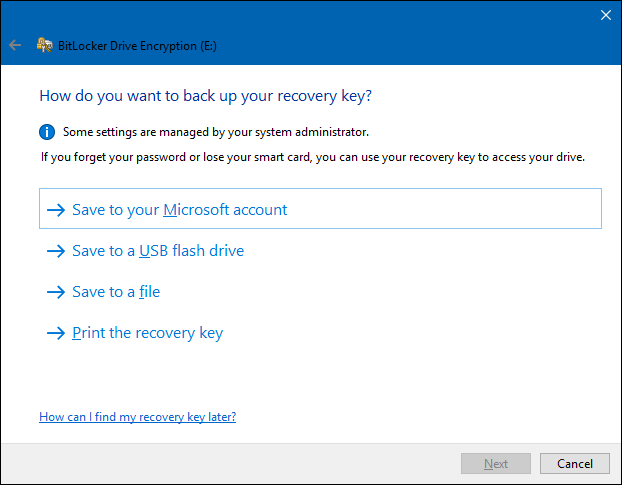
Your Bitlocker recovery key is uploaded to the Cloud with either an online account, or one-drive activation. It is illegal for Microsoft to reject assisting in cracking your machine.
What Bitlocker/TPM did accomplish was booby-trapping peoples PC. You are met with the recovery blue-screen if you went through the effort of installing an offline account, and tried to dual boot off the same physical drive. No one is told to backup your recovery key post install, and so the incentive to always use their shitty cloud options is encouraged with data loss.
Note too, NTFS will have encryption auto-enabled on anything you plug into Windows 11. Note, post-install it is non-trivial to fix the troublesome behavior.
Rufus is now the only way to install Windows 11 pro without the enshittification features:
https://github.com/pbatard/rufus/releases
Ripping out all the "AI" (undocumented API areas indicate snitch-ware), spam, and telemetry nonsense takes some effort. However, the only thing that should be running on windows now is the Steam launcher for classic games, and a tool to neuter most of the Microsoft malware.
https://www.oo-software.com/en/shutup10
It is sad, but Microsoft has some people willing to burn company goodwill for short-term gains. Even xbox now sucks, and that was easy money. =3
Look up YellowKey. Specifically crafted NTFS transaction logs would unlock any Bitlocker drive with transparent encryption. Some people believe it was an intentional backdoor, kind of a debated topic.
I'm not 100% certain either way.
>any Bitlocker drive with transparent encryption
Which even microsoft admits is basically a LARP from a security point of view. It's better than nothing, but it's not meant to stand up against serious attacks. Even without the yellowkey exploit, it can be bypassed via interposer attacks on the TPM.
https://learn.microsoft.com/en-us/windows/security/operating...
Why would they do it this way? If they're going to add a custom controller on the outside, why not make it encrypt before writing to the SD card?
Because incompetence.
[flagged]
Lenovo the goat
Model name checks out (FU100)
https://github.com/hparadiz/nexus-6p-biokey
I turned an old android into a fingerprint USB and a fido2 in one shot.
The fingerprint USB is actually legit since it's backed by a closed bio metric on device.
I don't know why, but I find it pretty funny.
Surely this is straight fraud?
Didn't expect something this crazy but I will not trust stuff like this until I've seen a teardown. Imagine being the product manager who approved this shit
As things are, they probably don't even know there is a website called hacker news.
Just buy a standard USB drive and encrypt it with Bitlocker. If you hate MS then use Veracrypt.
What am I missing here?
A fingerprint sensor?
If you don't believe your hardware than a FR wouldn't help you.
And if you cut or burn your finger or the sensor gets damaged in your pocket?
I have friends who have been locked out of their phone because they put all their trust in the fingerprint reader.
And forgot their PIN/password? That Apple forces you to use every 8 days or so?
Apple is not the only phone vendor.
if you use apple.com/icloud.com it will force user to use mfa every 1 hour. Apple got horrible engineering.
Well it's called FU after all...
[flagged]
[dead]
[flagged]
Just use veracrypt or ecrypt on any memory card. These devices don't deserve the premium they charge for on-device encryption which in this case is not even encyrypted
Were semicolons in subheadings common before AI? This subheading of the TomsHardware article just seems very artificial:
> The fingerprint only switched the USB connection on; nothing on the card was encrypted.
Oh god dammit, I have to stop using semicolons now? That's stupid.
Less semicolons overall, more the "statement; reveal/impact" formula that current frontier models like.
They were if you read a news source that catered to literate readers.
Not long ago it would have been an em dash.
I mean, it's a terrible subheading because it's way too long, but it's grammatically correct. It doesn't read like AI to me, why do you think it is?
The issue with AI-produced text is rarely bad grammar these days (if anything, that's a marker of human-written text now!), but rather stiff-sounding constructions that humans don't actually use. In this case — semicolons are grammatically correct, but very few people actually use them them (same for em-dashes like what I just used, but you can pry them from my cold, dead fingers).
I absolutely use semicolons when writing professionally. They're just basic parts of grammar, and if you want to be taken seriously by some parts of the world (academia, I'm glaring angrily at you), you would use them.
I guess it comes down to expectations? You don't expect formal conventions from a website writer, while I absolutely do.
I find it interesting that it was a flag for AI writing for you. That's going to make me consider my voice in certain situations now.
I’d expect people writing for a living to understand and use semicolons.